A city on the Euphrates that gave the world one of its most famous law codes, a gate of shining blue bricks, and astronomers who tracked the planets night after night for centuries.
The short version
Babylon was a city on the Euphrates River in the middle of what is now Iraq. Its ruins are near the town of Hillah, about 85 km south of Baghdad.
Around 1792 BCE a king called Hammurabi came to the throne. He joined the cities of southern Mesopotamia into one kingdom and had his laws carved on a tall stone. Some of them say "an eye for an eye".
Babylon was ruled by other peoples for long stretches, and it was often a rival of Assyria in the north. In 612 BCE the Babylonians and their allies captured the Assyrian city of Nineveh.
King Nebuchadnezzar II then made Babylon one of the grandest cities in the world, with the bright blue Ishtar Gate covered in lions, bulls and dragons.
Babylonian scholars watched the sky carefully and were brilliant at maths. In 539 BCE King Cyrus of Persia took the city, and Babylon never had its own kings again. Today its ruins are a World Heritage Site.
Where was Babylon?
Babylon stood on the Euphrates, close to where the Tigris and Euphrates come nearest to each other. That made it a good place for trade and for controlling the canals that watered the fields of the south. The ruins lie just north of Hillah, in Babil Province, and you can find it on the map.
𒆍𒀭𒊏𒆠
Scribes wrote the city's name with signs read KA.DINGIR.RA.KI, meaning "gate of the god" plus a sign for "place". In Akkadian it was Bāb-ili. The Greeks turned that into "Babylon".
Where in the worldBabylon stood on the Euphrates, about 85 km south of modern Baghdad. The shaded area shows roughly how much Hammurabi ruled near the end of his reign, c. 1750 BCE. See the full map. Mesopotamia guide · modern borders and rivers, simplified
Three ages of Babylon
Old Babylonian · c. 1894 to 1595 BCE
Hammurabi's kingdom
A family of Amorite kings made Babylon their base. The sixth of them, Hammurabi, turned a small city-state into the leading power of southern Mesopotamia.
Kassite · about 1595 to 1155 BCE
Four quiet centuries
Kassite kings, who came from the Zagros mountains, ruled Babylon for over 400 years, longer than any other dynasty. They kept Babylonian culture going and wrote to the pharaohs of Egypt as equals.
Neo-Babylonian · 626 to 539 BCE
An empire
After breaking free of Assyria, Babylon ruled an empire from the Gulf to the Mediterranean for less than a century, under kings like Nabopolassar and Nebuchadnezzar II.
Hammurabi: the king who united the land
Hammurabi ruled from c. 1792 to 1750 BCE. His family were Amorites, a people who spoke a language related to Akkadian and who had settled in many Mesopotamian cities. When he became king, Babylon was one of several rival kingdoms. Over about 30 years of alliances, deals and wars he defeated Larsa in the south and Mari on the middle Euphrates, and united most of Mesopotamia under Babylon.
Hammurabi was a hands-on ruler. Dozens of his letters survive, telling officials to dredge a blocked canal, settle a land dispute or send workers for the harvest. They show a king who wanted to be seen as fair and well organised.
Who were the Amorites?
"Amorite" comes from the Akkadian word Amurru, "the west". The Amorites were herding peoples from the steppes of Syria, west of Mesopotamia, who moved into the river valleys from around 2000 BCE. The kings of Ur III even built a long wall to try to keep them out. Within a few generations Amorite families ruled Babylon, Larsa, Mari and other cities, and they wrote in Akkadian like everyone else.
The laws on the stone
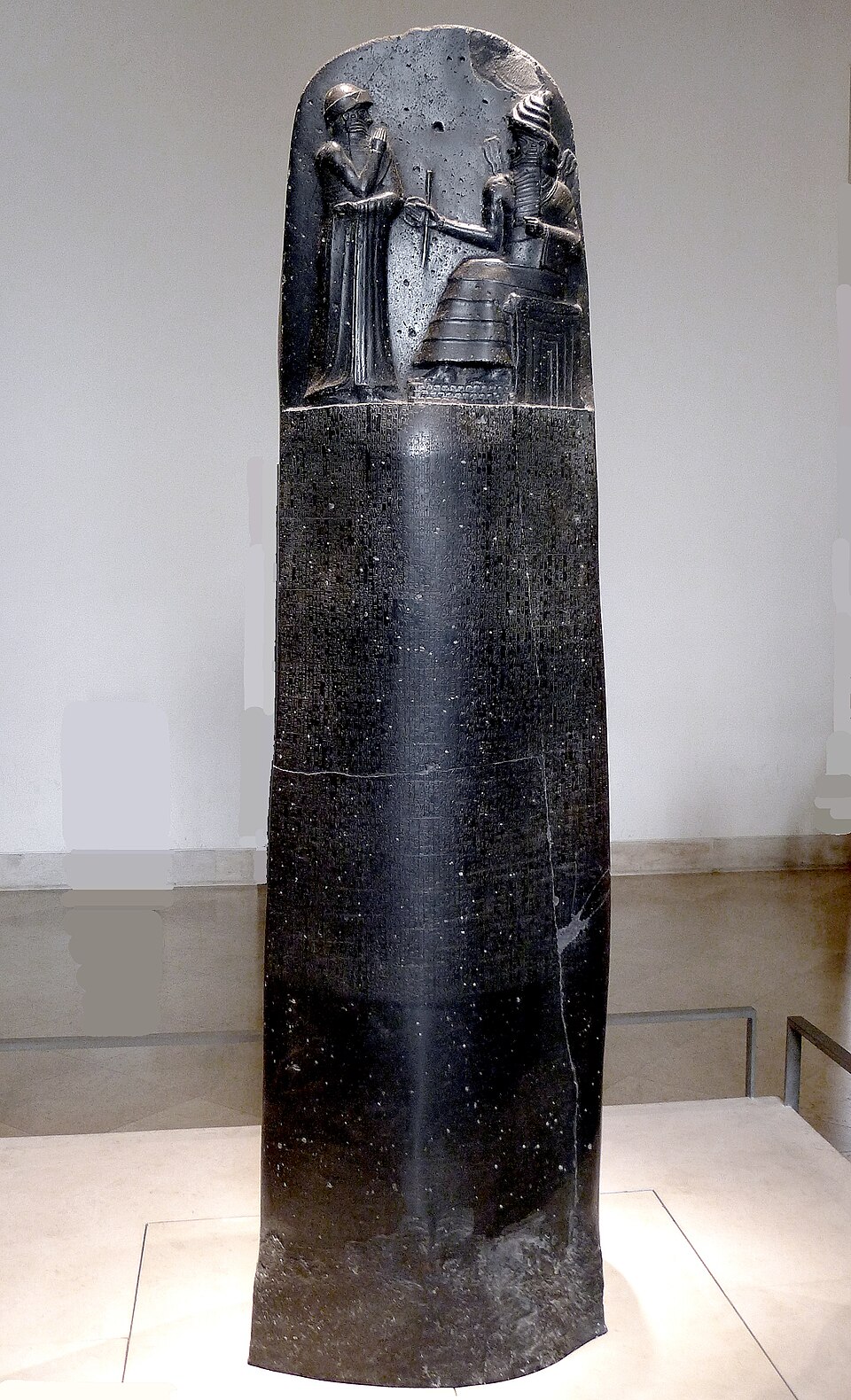
Near the end of his reign, around 1754 BCE, Hammurabi had about 282 laws carved on a black stone pillar about 2.25 metres tall, in Akkadian cuneiform. At the top, he stands before Shamash, the sun god and god of justice. Copies stood in different cities so people could see that the king cared about justice.
Hammurabi's code was not the first. The Sumerian Code of Ur-Nammu is about 350 years older. But Hammurabi's is the longest and best preserved law code from the ancient world, and scribes kept copying it for over a thousand years.
Law 196If a man destroys the eye of a free man, his own eye shall be destroyed.
Law 198If he destroys the eye of a commoner, he shall pay one mina of silver.
Law 199If he destroys the eye of someone's slave, he shall pay half of the slave's price.
Law 53If a man is too lazy to keep his part of a dam in repair, and the dam breaks and floods the fields, he must pay for the grain he has ruined.
Look closely at laws 196 to 199. "An eye for an eye" only applied between equals. The same injury cost less if the victim was a commoner, and less again if they were enslaved. Babylonian society had three main groups: free people, commoners and slaves, and the law treated them differently.
Kings to know
King
Reigned (BCE)
Known for
Hammurabi
c. 1792 to 1750
United southern Mesopotamia; his law code and letters.
Nebuchadnezzar I
c. 1125 to 1104
Brought the statue of Marduk home from Elam, a story Babylonians told for centuries.
Nabopolassar
626 to 605
Freed Babylon from Assyria and, with the Medes, captured Nineveh in 612.
Nebuchadnezzar II
605 to 562
Rebuilt Babylon with the Ishtar Gate and the great ziggurat; captured Jerusalem.
Nabonidus
556 to 539
The last king. Spent about ten years in Arabia, leaving his son Belshazzar in charge of Babylon.
The Kassite centuries
In about 1595 BCE a Hittite army from Anatolia (modern Turkey), led by King Mursili I, raided and sacked Babylon, ending Hammurabi's dynasty. Into the gap stepped the Kassites. They ruled Babylon until 1155 BCE. They took on Babylonian gods, language and writing, set up carved boundary stones called kudurru to record land grants, and traded and wrote letters with Egypt, the Hittites and Assyria.
The Kassites came from the Zagros mountains to the east. Their own language is almost lost: we know it mainly from names and a few word lists. One Kassite king, Kurigalzu I, built a new royal city now called Aqar Quf, about 30 km west of the centre of modern Baghdad, and the core of its ziggurat still stands there today.
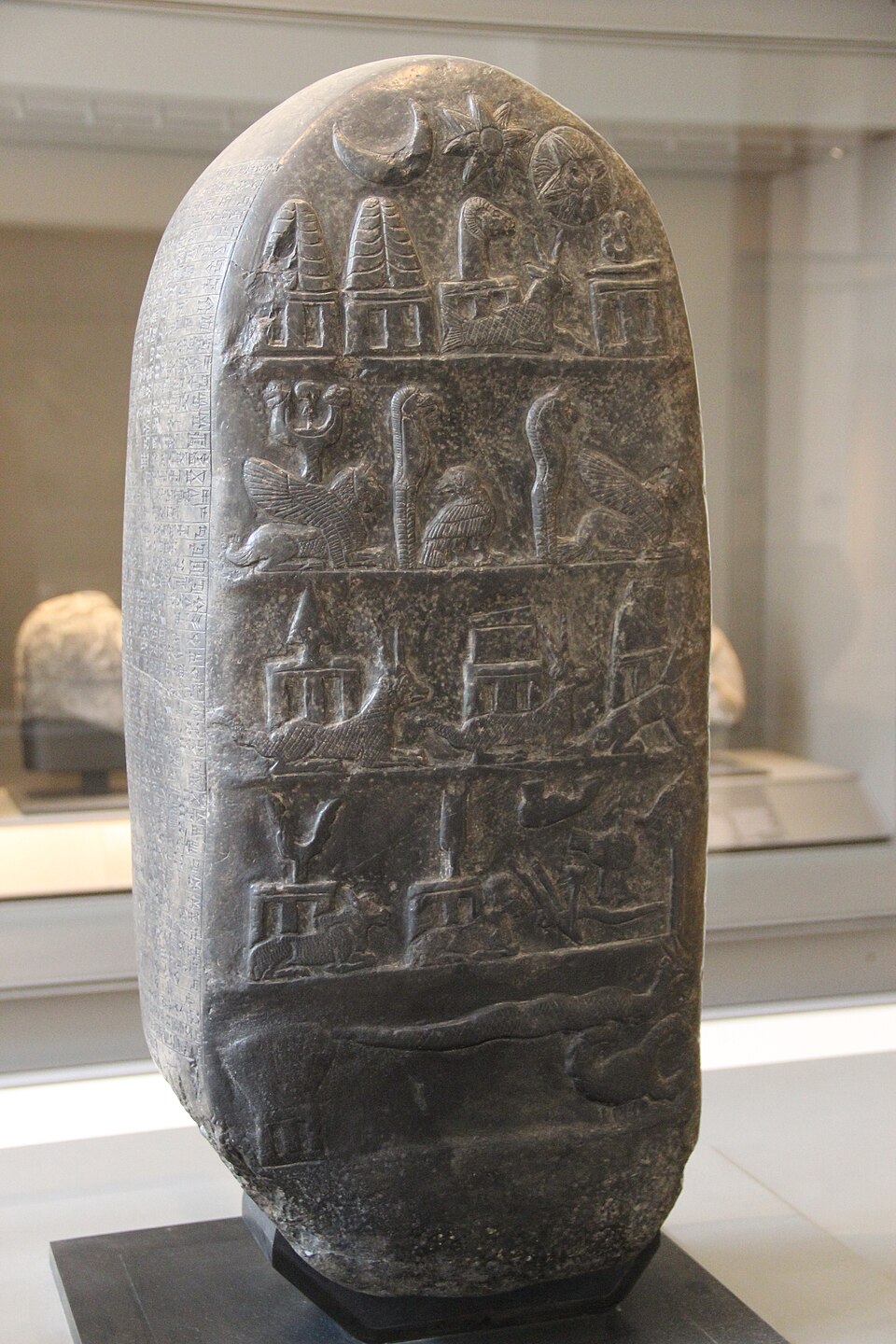
A Kassite kudurruBoundary stone of King Meli-Shipak (c. 1186 to 1172 BCE), recording a gift of land to his son. The symbols of the gods were meant to protect the deal. Louvre Museum, Paris. Gary Todd · CC0
Marduk and the Enuma Elish
Marduk was Babylon's own god. As the city grew more important, so did he, until Babylonians saw him as king of all the gods. A long poem called the Enuma Elish ("When on high", its first words) tells how Marduk defeated Tiamat, the goddess of the salty sea, and built the world from her body. Priests recited it during the New Year festival. These were the beliefs of the time, and they tell us how Babylonians explained their world and their city's place in it.
Babylon and Assyria: neighbours and rivals
Babylon and Assyria spoke forms of the same language, Akkadian, and worshipped many of the same gods. Assyrian kings admired Babylon's learning, yet the two fought for over a thousand years. Assyria conquered Babylon several times. In 689 BCE King Sennacherib flooded and wrecked the city after a revolt, and his son Esarhaddon then rebuilt it.
The tables turned in 626 BCE, when Nabopolassar drove the Assyrians out and became king of Babylon. He joined forces with the Medes of Iran. Together they took Assur in 614 BCE and Nineveh in 612 BCE. A clay tablet called the Fall of Nineveh Chronicle, now in the British Museum, tells the story from the Babylonian side, year by year.
Nebuchadnezzar's Babylon
Nebuchadnezzar II, Nabopolassar's son, ruled from 605 to 562 BCE, the longest reign of any Neo-Babylonian king. He spent much of the wealth of his empire on rebuilding Babylon. Millions of new bricks were stamped with his name, and many of them can still be found at the site.
The Ishtar Gate and the Processional Way
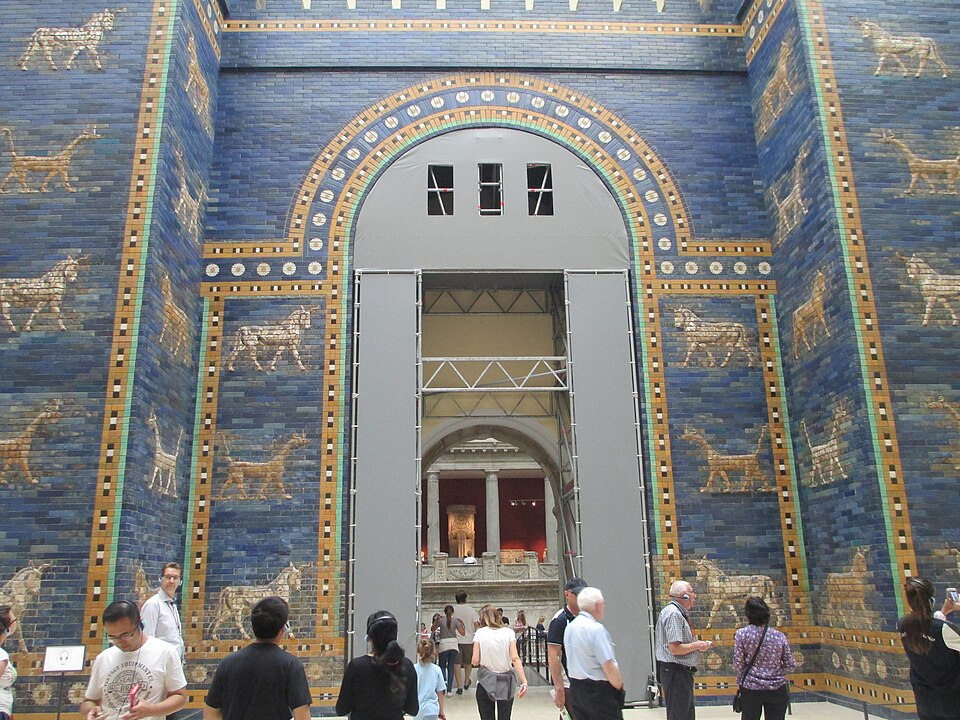
The northern entrance to the city was the Ishtar Gate, named after the goddess of love and war. It was covered in glazed bricks: bricks coated in glass-like colour and baked, so they shone deep blue. On them marched rows of bulls (for the weather god Adad) and dragons called mushhushshu (for Marduk).
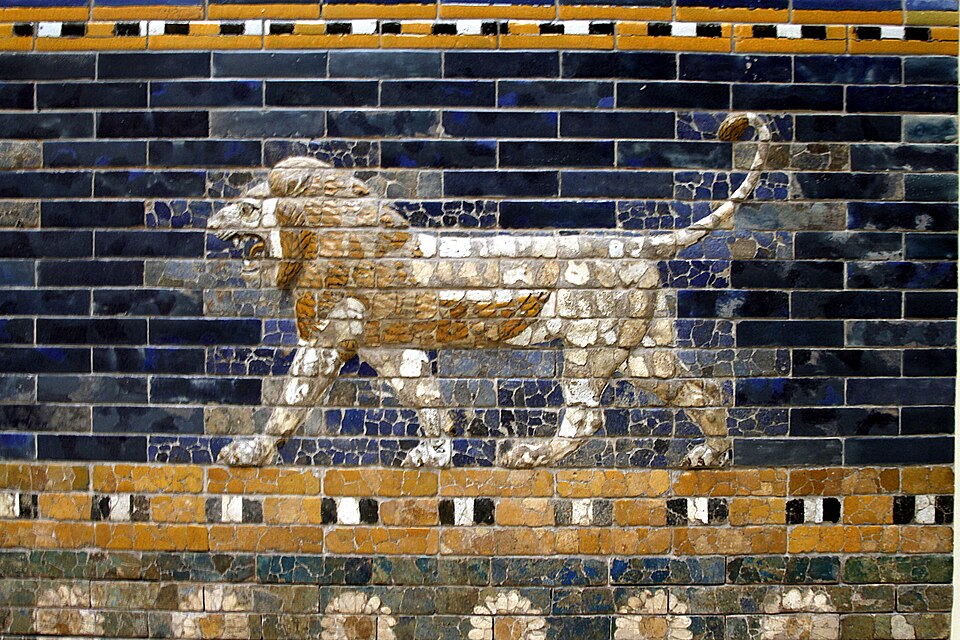
Through the gate ran the Processional Way, a wide street lined with about 120 striding lions, the animal of Ishtar. Statues of the gods were carried along it during the New Year festival.
German archaeologists led by Robert Koldewey dug up thousands of broken glazed bricks between 1899 and 1917. In Berlin, experts pieced the front of the gate and part of the street back together, and it has stood in the Pergamon Museum since 1930. Lions from the Processional Way are also in museums in Istanbul, Paris, New York, Toronto and elsewhere. A copy of the gate stands at Babylon itself.
A lion of the Processional WayA striding lion from the Processional Way, Babylon, c. 575 BCE. Pergamon Museum, Berlin. José Luiz · CC BY-SA 4.0
Etemenanki, the great ziggurat
Babylon's ziggurat, Etemenanki ("house of the foundation of heaven and earth"), stood beside Esagila, the temple of Marduk. Nebuchadnezzar finished rebuilding it. It may have reached about 90 metres high (an estimate). Many historians think it may have inspired the story of the Tower of Babel in the Bible. Today only the outline of its base survives.
The Hanging Gardens: real or not?
Later Greek writers listed the Hanging Gardens of Babylon as a wonder of the world. But no Babylonian text mentions them, and archaeologists have not found them. They may never have existed, or they may have been the famous gardens of the Assyrian king Sennacherib at Nineveh. Scholars still debate it.
Jerusalem, 597 and 587/586 BCE
Nebuchadnezzar's armies fought Egypt for control of the lands along the Mediterranean, including the kingdom of Judah. In 597 BCE he captured Jerusalem and took its king to Babylon. After a later revolt, his army captured the city again in 587 or 586 BCE and destroyed its temple, and many people of Judah were moved to Babylonia. This period is known as the Babylonian exile.
Stargazers and mathematicians
Babylonian scribes were among the best mathematicians and astronomers of the ancient world. They used the base-60 number system that came from Sumer, and they could solve problems that schoolchildren today meet in high school.
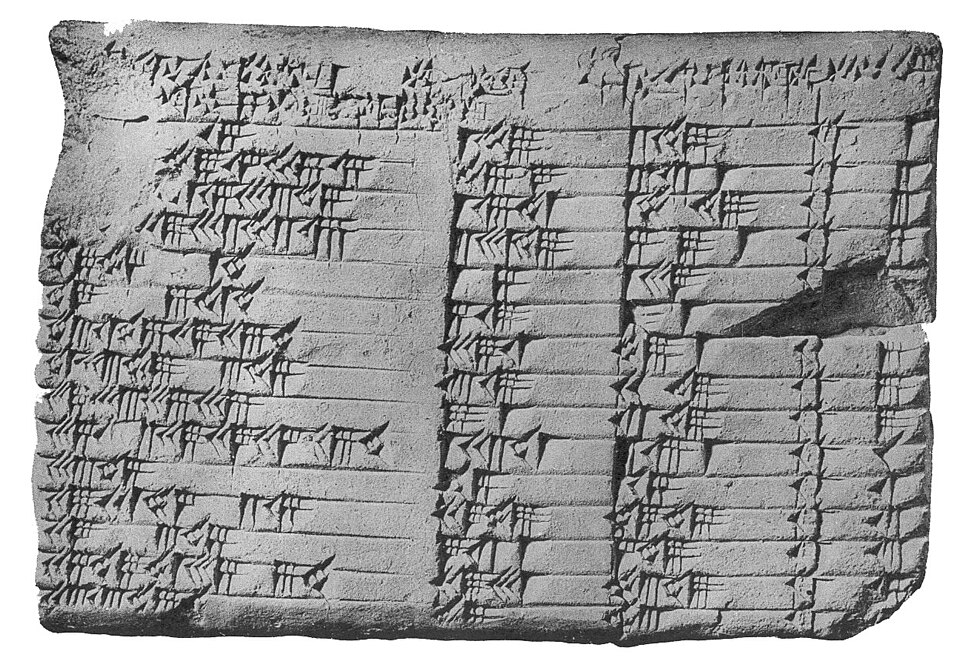
A clay tablet known as Plimpton 322, written around 1800 BCE, lists sets of numbers that fit the rule for right-angled triangles (a² + b² = c²). That is more than a thousand years before the Greek thinker Pythagoras, after whom the rule is named.
Astronomers watched the night sky from Babylon and recorded the Moon, the planets and the weather in Astronomical Diaries, kept for about 600 years. Using these records they could predict eclipses and work out where planets like Jupiter would appear. The twelve signs of the zodiac, each 30 degrees wide, also come from Babylonia.
Plimpton 322Plimpton 322, an Old Babylonian maths tablet, c. 1800 BCE. Columbia University, New York. Unknown photographer · Public domain
The oldest known map of the world
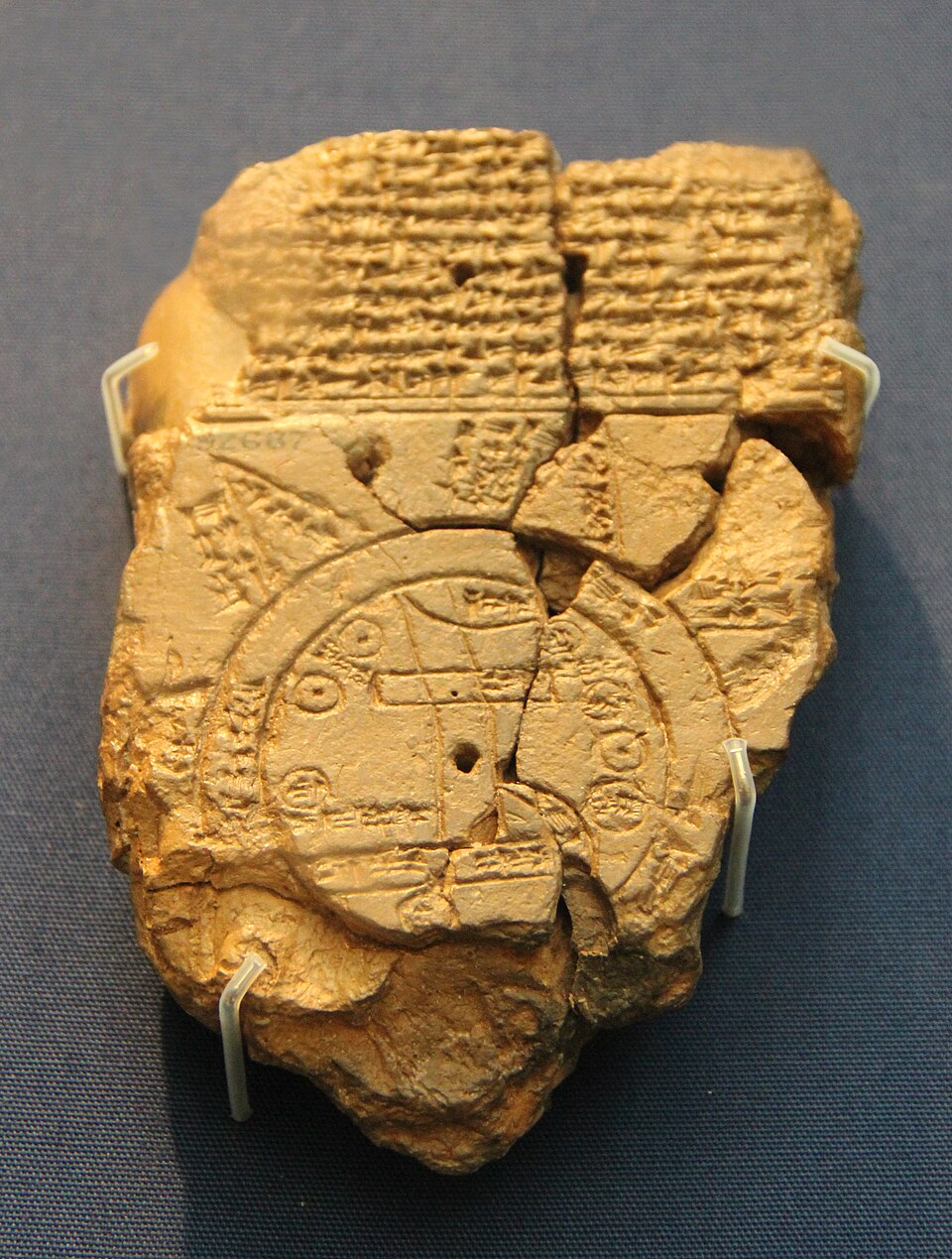
This small clay tablet, from the city of Sippar, is often called the oldest known map of the world. It was made around 700 to 500 BCE, perhaps copied from an older original.
It is not a map for finding your way. It shows the world as Babylonians imagined it. Babylon sits near the middle, with the Euphrates running through it. Around the land runs a ring of water, the "bitter river". Beyond it, triangles point to faraway regions, and the writing describes strange places and animals there.
Look for the small circles: they stand for cities and lands, including Assyria and the mountains of Urartu. Try comparing it with our own map.
The Babylonian Map of the WorldClay tablet from Sippar, c. 700 to 500 BCE, about 12 cm tall. The double circle is the ring of water around the known world. British Museum, London. Gary Todd · CC0
The last kings of Babylon
The last king, Nabonidus (556 to 539 BCE), was devoted to the moon god Sin, which upset some of Marduk's priests. For about ten years he lived at the oasis of Tayma in Arabia, while his son Belshazzar ran Babylon. Meanwhile Cyrus the Great of Persia was building a vast empire. In 539 BCE Cyrus defeated the Babylonian army, and his troops entered Babylon, apparently without a fight inside the city. Babylon became part of the Persian Empire.
Epilogue. Babylon stayed a great city for centuries. Alexander the Great planned to make it a capital, and he died there, in Nebuchadnezzar's palace, in 323 BCE. Scholars kept writing in cuneiform at Babylon and Uruk long after everyone else had switched to other scripts. The last cuneiform tablets we know of are astronomical records from around 75 CE, which ended a writing tradition about 3,300 years old.
Babylon today
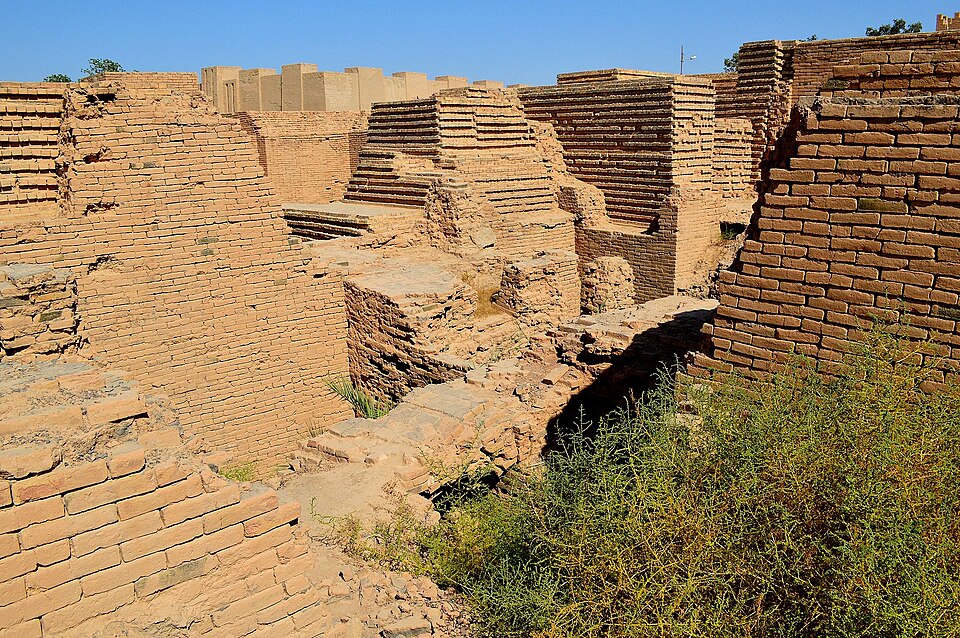
Walking through BabylonBrick walls at the site of Babylon near Hillah, photographed in 2012. Some walls date from Nebuchadnezzar II's city in the 6th century BCE; others were rebuilt on top of them in the 1980s. Osama Shukir Muhammed Amin FRCP(Glasg) · CC BY-SA 4.0
Babylon became a UNESCO World Heritage Site in 2019. Visitors walk among mud-brick walls, the base of the Ishtar Gate with its unglazed bulls and dragons still in place, and the Lion of Babylon, a large ancient stone statue of a lion. In the 1980s, parts of Nebuchadnezzar's palace were rebuilt on top of the ancient walls using new bricks. Many archaeologists think this harmed the original remains, and today Iraq's State Board of Antiquities and Heritage works with international partners on careful conservation. Like the rest of Mesopotamia's past, Babylon belongs to all Iraqis: Arab, Assyrian, Kurdish, Mandaean, Yazidi, Turkmen and others. See more on Then & Now.
The law code stele of Hammurabi
Hammurabi's law steleThe stele of Hammurabi's laws, c. 1754 BCE. Louvre, Paris. Mbzt · CC BY 3.0
Origin
Carved for Hammurabi of Babylon around 1754 BCE. Around 1158 BCE an Elamite king carried it off as loot to Susa, in today's Iran, where French archaeologists found it in 1901 to 1902. It is now in the Louvre in Paris.
Purpose
To show Hammurabi as a just king chosen by the gods. The long introduction and ending praise him and curse anyone who damages the stone. It may have been more a royal statement of fairness than a rulebook judges looked up.
What it shows
Hammurabi standing before the seated sun god Shamash, then about 282 laws in Akkadian cuneiform on trade, farming, family, theft, injuries and slavery. A few columns were rubbed off in ancient times, probably by the Elamites.
How useful?
Very useful for Babylonian ideas of justice, social classes, family life and the economy. Limits: it tells us what the king wanted the law to be, not how courts actually worked, and it shows the view of the ruler, not of ordinary or enslaved people. Comparing it with real court records and contracts from the time helps.
The Ishtar Gate
The Ishtar GateThe rebuilt front of the Ishtar Gate, c. 575 BCE, in the Pergamon Museum, Berlin. Avi1111 dr. avishai teicher · CC BY-SA 4.0
Origin
Built for Nebuchadnezzar II at the northern entrance of Babylon, around 575 BCE. Excavated by a German team from 1899 to 1917 and rebuilt in Berlin from the original broken bricks, with new bricks filling the gaps. On show since 1930. The Pergamon Museum closed in October 2023 for a long renovation; the Ishtar Gate hall is expected to reopen around 2037.
Purpose
To protect the city, to honour the gods Ishtar, Adad and Marduk, and to amaze anyone entering Babylon with the king's wealth and power. A long inscription by Nebuchadnezzar explains that he built it.
What it shows
Rows of bulls and mushhushshu dragons in glazed brick. What you see in Berlin is the smaller front gate; the larger rear gate was too big to fit in the museum.
How useful?
Very useful for Babylonian technology (glazing), religion and royal display. Limits: what stands in Berlin is a modern reconstruction, it shows only the king's view, and it was moved far from Babylon, so we lose its original setting. That raises a question worth discussing: where should objects like this be kept today?
The Cyrus Cylinder
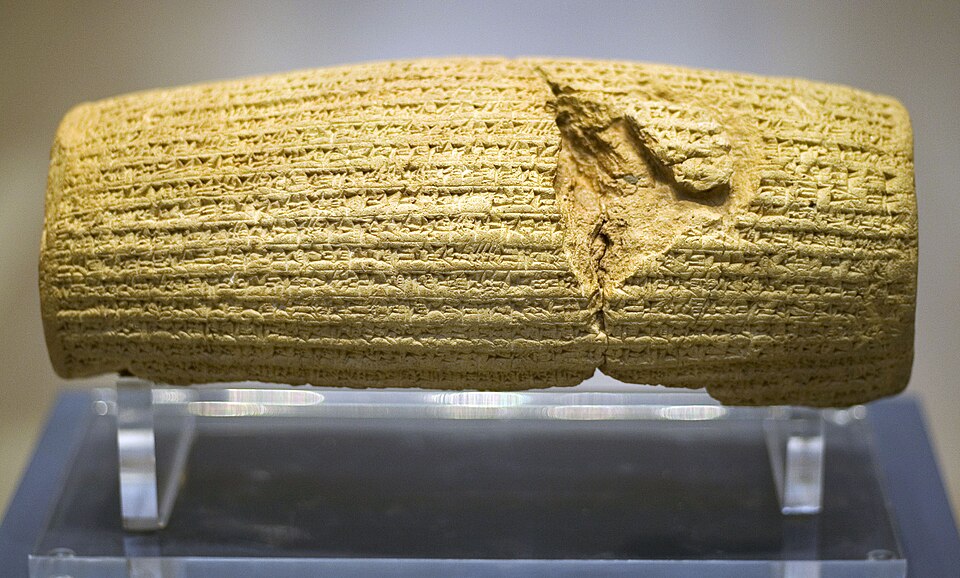
The Cyrus CylinderThe Cyrus Cylinder, written soon after 539 BCE, found at Babylon. British Museum. Prioryman · CC BY-SA 3.0
Origin
Written in Akkadian cuneiform at Babylon soon after Cyrus took the city in 539 BCE, and buried in the foundations of a city wall. Found in 1879 by Hormuzd Rassam, the archaeologist from Mosul. Now in the British Museum.
Purpose
To present Cyrus as a lawful Babylonian king, chosen by Marduk, and to make the last Babylonian king, Nabonidus, look bad.
What it shows
Cyrus says he entered Babylon in peace, restored temples, and let peoples and gods who had been moved return to their homes.
How useful?
Useful for how Persian kings presented themselves and for the end of the Babylonian kingdom. Limits: it is victor's propaganda, written in the old Mesopotamian style of royal boasting. It is sometimes called "the first charter of human rights", but most historians say that is a modern reading, not what it meant at the time.
Early dates are estimates; scholars disagree by up to about 60 years. Neo-Babylonian dates (from 626 BCE) are exact.
Dig deeper
Was Hammurabi's code really "law"?
Thousands of Old Babylonian contracts and court records survive, and they almost never quote the code. That has led scholars such as Martha Roth and Raymond Westbrook to debate what it was for. Some see it as a collection of model judgements, like a textbook of good justice; others as royal propaganda presenting the king as "shepherd" of his people. The phrase "eye for an eye" (Latin lex talionis) also appears in later legal traditions, including the Hebrew Bible. Read a translation: Martha T. Roth, Law Collections from Mesopotamia and Asia Minor (1997).
The chronology problem
Hammurabi's dates depend on which chronology you use: 1792 to 1750 BCE in the Middle Chronology, about 1848 to 1806 in the High, or 1728 to 1686 in the Low. A key clue is the Venus Tablet of Ammisaduqa, a record of the planet Venus made under a later king of Hammurabi's dynasty. Because Venus repeats its patterns, the record fits several possible dates. Tree-ring and radiocarbon studies broadly support the Middle Chronology. From 626 BCE, Babylonian dates are exact.
The Hanging Gardens debate
The gardens are first described by Greek and Roman writers, the earliest being the Babylonian priest Berossus, writing in Greek around 290 BCE, whose work survives only in quotations. Nebuchadnezzar left many building inscriptions and none mention gardens. Stephanie Dalley, in The Mystery of the Hanging Garden of Babylon (2013), argues they were Sennacherib's gardens at Nineveh, watered by his canals and aqueducts. Other scholars are not convinced. It is a good example of how historians weigh later accounts against the silence of earlier sources.
Babylon and the Bible
Babylon appears often in the Hebrew Bible, which tells the story of Jerusalem's fall from Judah's point of view. Babylonian sources add their own side: the Babylonian Chronicle records the capture of Jerusalem in 597 BCE, and ration tablets found at Babylon list oil given to "Jehoiachin, king of Judah" and his sons. Comparing these independent sources is a good exercise in corroboration.
The astronomers of Babylon
The Astronomical Diaries run from about 652 BCE to about 61 BCE. In 2016 the historian of science Mathieu Ossendrijver showed that some tablets calculate Jupiter's movement using the area under a graph, a method once thought to have been invented in medieval Europe. Babylonian records later helped Greek astronomers such as Hipparchus. On Plimpton 322, see Eleanor Robson's articles, which argue it was probably a teacher's aid rather than a trigonometry table.
Babylon as a heritage site
The modern rebuilding of the 1980s used new bricks laid on top of ancient walls, which made parts of the site hard to study and was one reason Babylon took until 2019 to be inscribed by UNESCO. The site was also damaged when used as a military base in 2003 and 2004, documented in a 2004 British Museum report by John Curtis. Since then Iraqi heritage professionals, with groups such as the World Monuments Fund, have worked on conservation and a management plan.