From a trading town on the Tigris grew one of the largest empires the ancient world had seen, with palaces guarded by giant stone spirits and a library that saved the story of Gilgamesh.
The short version
Assyria began in the north of what is now Iraq, around the city of Assur, named after its chief god. At first it was a city of traders. Over about 1,400 years it grew into a powerful kingdom and then a huge empire.
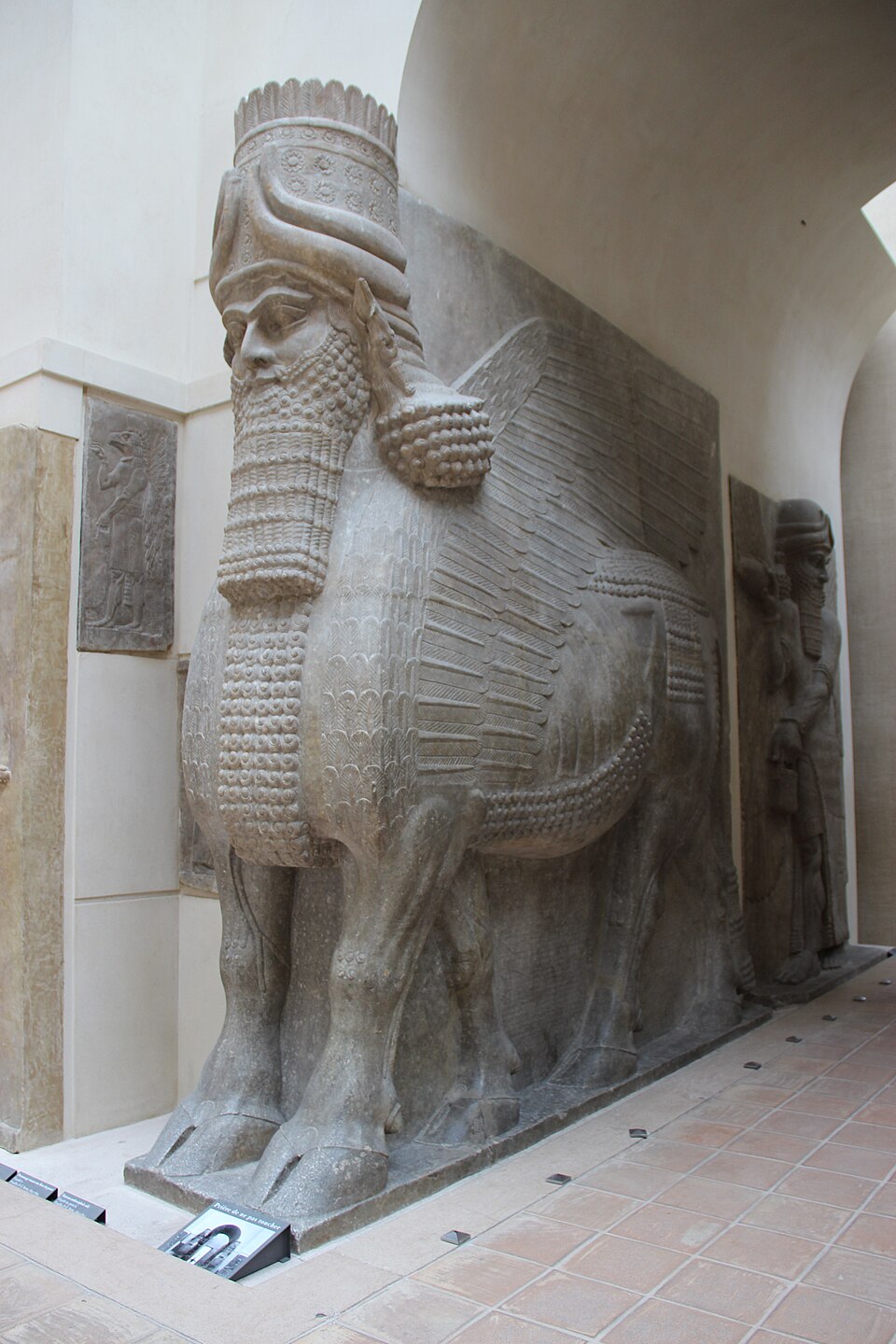
Assyrian kings built enormous palaces at Nimrud, Khorsabad and Nineveh (across the river from today's Mosul). Giant stone guardians called lamassu, with a human head, wings and the body of a bull or lion, stood at the gates.
The kings were tough and often cruel in war. They forced conquered people to move to new lands and carved battle scenes on palace walls to show off their power.
King Ashurbanipal collected over 30,000 clay tablets in a great library. Thanks to him we can still read the Epic of Gilgamesh.
In 612 BCE Nineveh fell to the Babylonians and Medes. But the Assyrian people did not disappear: Assyrians still live in Iraq, and in Australia, today.
Where in the worldAssyria's heartland was in the hilly north of modern Iraq, along the Tigris from Assur up to Nineveh, which is now part of Mosul. The shaded area is approximate; at its peak the empire reached far beyond it. See the full map. Mesopotamia guide · modern borders and rivers, simplified
Three phases, one long story
Old Assyrian · c. 2025 to 1750 BCE
Merchants
Traders from Assur ran donkey caravans carrying tin and woollen cloth to Kanesh in Anatolia (modern Turkey). They left tens of thousands of business letters there. Shamshi-Adad I (c. 1808 to 1776 BCE) briefly built a large kingdom across the north.
Middle Assyrian · c. 1363 to 912 BCE
A kingdom
Ashur-uballit I (c. 1363 to 1330 BCE) wrote to the pharaoh of Egypt as an equal. Tukulti-Ninurta I (1243 to 1207 BCE) conquered Babylon, and Tiglath-Pileser I (1114 to 1076 BCE) campaigned as far as the Mediterranean.
Neo-Assyrian · 911 to 609 BCE
An empire
Starting with Adad-nirari II in 911 BCE, Assyria grew into an empire stretching from Iran to Egypt, covering an estimated 1 to 1.4 million square kilometres at its peak.
In between: the Hurrians and Mitanni
Why the gap between the first two phases? For part of that time, Assur was ruled by Mitanni, a kingdom centred in what is now north-eastern Syria. Its people were mostly Hurrians, who spoke a language unrelated to Sumerian or Akkadian, and Mitanni was famous for its horse-drawn chariots. Hurrians also lived in northern Iraq: thousands of their family tablets were found at Nuzi, near Kirkuk. As Mitanni weakened, Ashur-uballit I broke free, and later Assyrian kings took over what was left of it.
Four royal cities
Assur
At Qal'at Sherqat. The oldest capital and holy city of the god Ashur. Even after kings moved elsewhere, they were crowned and buried here.
Nimrud (Kalhu)
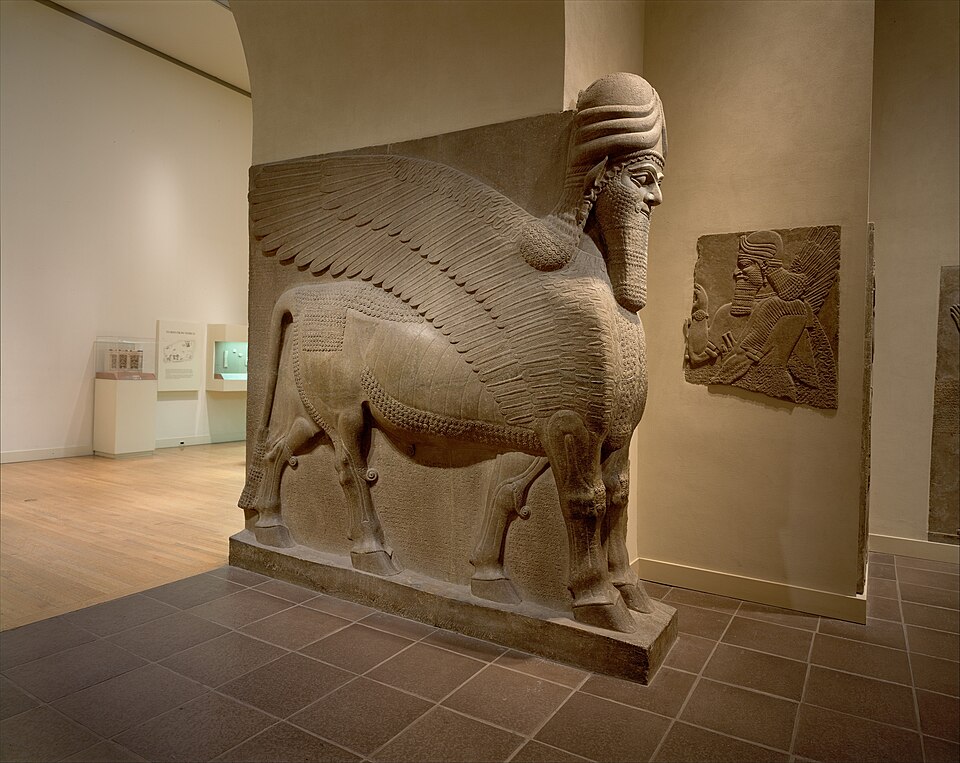
Ashurnasirpal II made it his capital. His Northwest Palace was lined with carved stone panels and guarded by lamassu.
Khorsabad (Dur-Sharrukin)
"Fortress of Sargon", a brand-new city built by Sargon II. He died in battle in 705 BCE, soon after it was finished, and it was largely abandoned.
Nineveh
In today's Mosul. Sennacherib made it the capital, with about 12 km of walls and an estimated 100,000 to 150,000 people. Its ruins at Kuyunjik and Nebi Yunus are inside the modern city.
A guardian from KhorsabadLamassu from the throne room of Sargon II's palace at Khorsabad, 721 to 705 BCE, over 4 metres tall. Louvre Museum, Paris. Gary Todd · CC0
Kings to know
King
Reigned (BCE)
Known for
Ashurnasirpal II
883 to 859
Rebuilt Nimrud as his capital; lamassu and palace reliefs. He claimed 69,574 guests came to the feast opening his palace.
Tiglath-Pileser III
745 to 727
Reorganised the empire into provinces run by governors, with a full-time army. Moved whole populations around the empire.
Sargon II
721 to 705
Built Khorsabad. Named himself after Sargon of Akkad, who had lived some 1,600 years earlier.
Sennacherib
705 to 681
Made Nineveh a grand capital with a "Palace without Rival", gardens, canals and the stone aqueduct at Jerwan. Besieged the city of Lachish in 701.
Ashurbanipal
669 to 631
The last great king. Proud that he could read and write, he built the famous library at Nineveh.
Neo-Assyrian dates are exact to the year. Scribes kept lists naming each year after an official, and one list mentions a solar eclipse that astronomers can date to 763 BCE, which locks the whole list in place.
Lamassu: guardians at the gate
A lamassu was a protective spirit. Pairs of them, carved from single blocks of stone up to about 4 metres tall, stood at palace doorways to scare off evil and impress visitors.
Count the legs: most have five. From the front you see two legs standing still. From the side you see four legs striding forward. The sculptors wanted it to look complete from either angle.
The horned cap shows it is divine, the wings link it to the sky, and the bull's body gives it strength.
A lamassu from NimrudA lamassu from Ashurnasirpal II's palace at Nimrud, 883 to 859 BCE. Metropolitan Museum of Art, New York. Metropolitan Museum of Art · CC0
Achievements
A library sorted by subject
Ashurbanipal's scribes collected and copied texts on medicine, omens, maths, prayers, word lists and stories, and organised them by subject.
Water engineering
Sennacherib's canals brought mountain water to Nineveh. The Jerwan aqueduct, built of about two million stone blocks, carried a canal across a valley.
Roads and messengers
A royal road system with relay stations let messengers swap mules and carry letters across the empire in days instead of weeks.
Palace art
Carved stone panels showed hunts, battles, ceremonies and protective spirits in fine detail. They are among the treasures of museums around the world.
The royal lion hunt
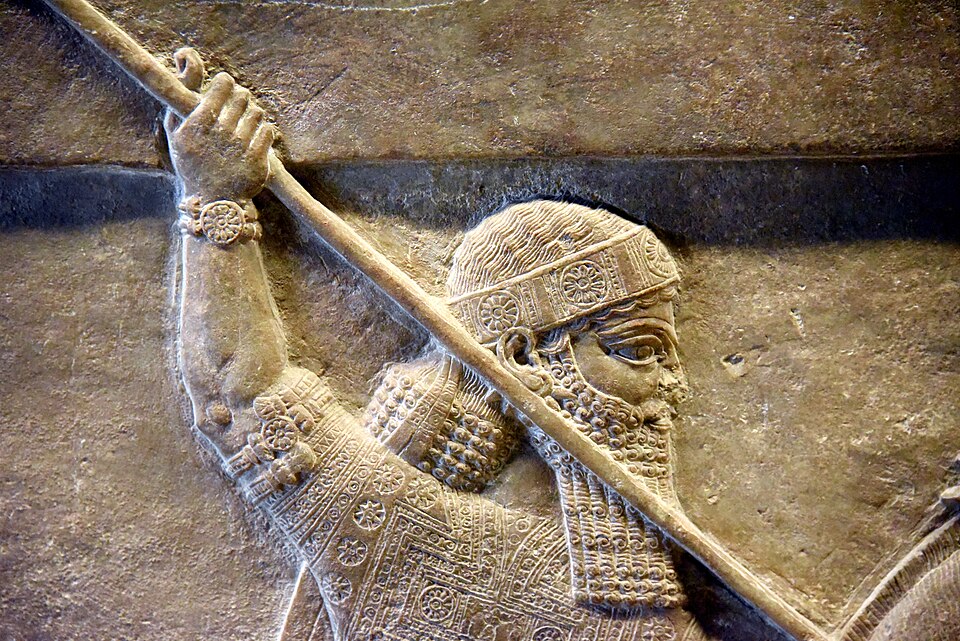
Lions still roamed northern Mesopotamia, and they stood for the wild dangers outside the city. Hunting them was a royal duty: by facing lions, the king showed he could protect his people.
The most famous hunt scenes come from Ashurbanipal's North Palace at Nineveh, carved around 645 to 635 BCE. They show the king on horseback and on foot, his servants, hunting dogs and the lions themselves, carved so carefully that you can see every muscle. Many visitors find the lions the most moving part.
Like all palace art, these panels were royal propaganda. The hunts took place in a closed arena, with lions released from cages, so the danger was carefully controlled.
Ashurbanipal huntingDetail of a lion-hunt relief from the North Palace at Nineveh, c. 645 to 635 BCE. British Museum, London. Osama Shukir Muhammed Amin FRCP(Glasg) · CC BY-SA 4.0
Ashurbanipal's library and the Flood Tablet
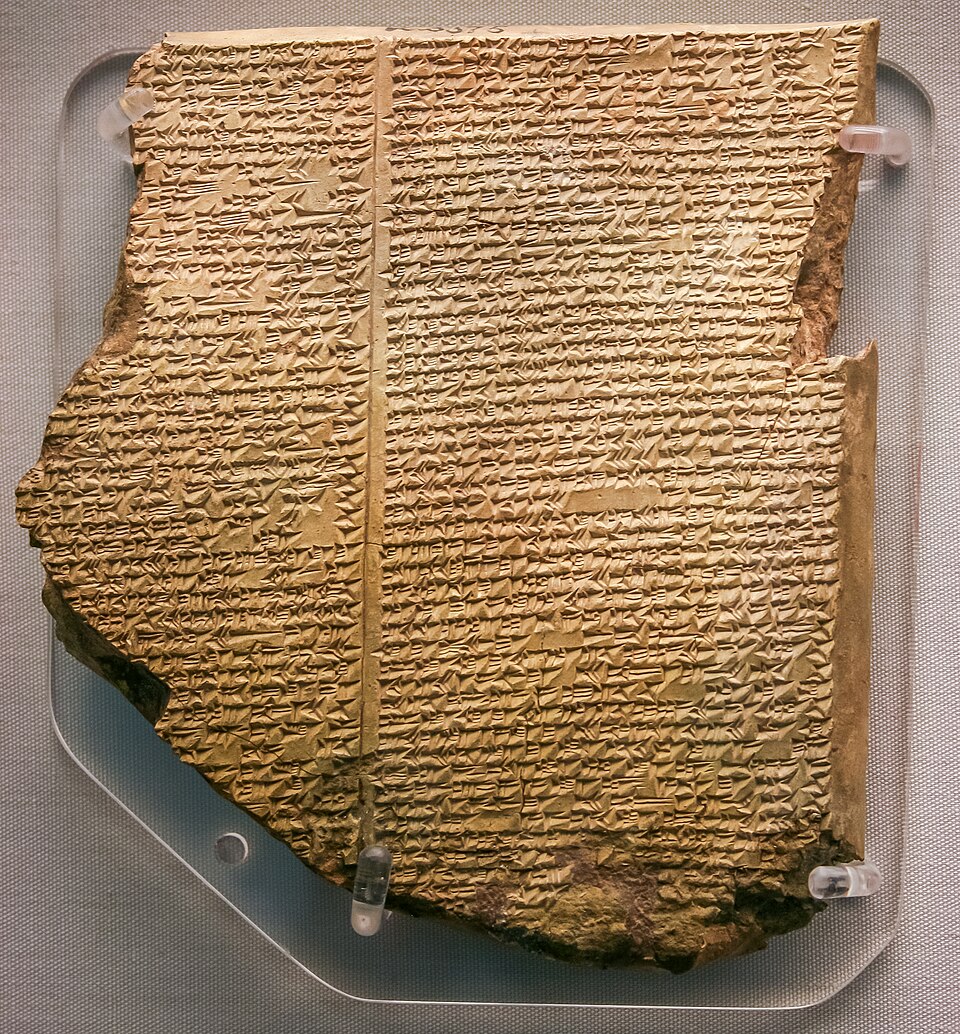
Archaeologists digging at Nineveh in the 1840s and 1850s, including Austen Henry Layard and the Mosul-born Hormuzd Rassam, found rooms full of broken tablets. Today the British Museum holds more than 30,000 tablets and fragments from the library.
In 1872 a young museum assistant, George Smith, was sorting fragments when he read a story of a great flood, a boat and a bird sent out to find dry land. It was Tablet 11 of the Epic of Gilgamesh, in which a man named Utnapishtim tells Gilgamesh how he survived the flood. The story is older than Assyria: earlier versions were written in Babylonia, and it shares features with the later flood story in the Bible.
The Flood TabletThe Flood Tablet, Tablet 11 of the Epic of Gilgamesh, from Ashurbanipal's library at Nineveh, 7th century BCE. British Museum. Mike Peel (www.mikepeel.net) · CC BY-SA 4.0
The hard side of empire
It would be dishonest to leave this out. Assyrian kings ruled through fear as well as organisation. Cities that rebelled were attacked and burned, and their leaders punished harshly. Kings boasted about this in their inscriptions.
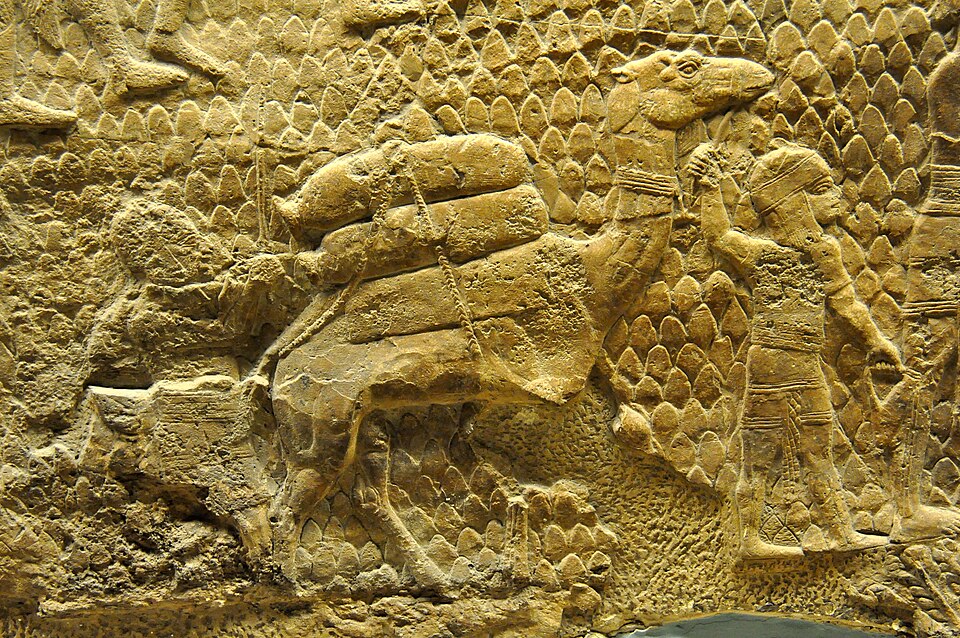
Their most common policy was deportation: moving whole communities hundreds of kilometres to another part of the empire, to break up resistance and to supply workers and soldiers. Families walked with their belongings, as the relief on the right shows.
The palace carvings were propaganda (art made to persuade). Visitors walking past scenes of Assyrian victories were meant to think: do not rebel. That means we should read them as the king's version of events, not a neutral record.
Leaving LachishPeople of Lachish being deported, from Sennacherib's palace at Nineveh, c. 700 to 692 BCE. British Museum. Osama Shukir Muhammed Amin FRCP(Glasg) · CC BY-SA 4.0
The fall of Nineveh
After Ashurbanipal died, his sons fought each other while enemies grew stronger. The Babylonians, led by Nabopolassar, and the Medes from Iran, led by Cyaxares, joined forces. Assur fell in 614 BCE, and Nineveh fell in 612 BCE. The last Assyrian king, Ashur-uballit II, made a final stand at Harran in 609 BCE and then disappears from history. Fire may even have helped some clay tablets survive, by baking them hard.
The Arameans and a language that lasted
From about 1100 BCE, Assyria's western neighbours were the Arameans, groups of herders and small kingdoms spread across Syria and the middle Euphrates. They fought Assyria for centuries, and one by one their lands became Assyrian provinces.
Their language, Aramaic, spread the other way. It was written with a short alphabet of 22 letters, far easier to learn than hundreds of cuneiform signs, and deported families carried it all over the empire. By the 700s BCE, Assyrian officials used Aramaic alongside Akkadian, and palace carvings show pairs of scribes: one pressing a tablet, the other writing with a pen on a scroll.
Aramaic never disappeared. Today's Assyrians speak modern forms of it (Neo-Aramaic, often called Sureth), and Syriac, an older form, is still used in their churches. Mandaeans keep a form of Aramaic alive too. It is one of the longest-living languages in the world.
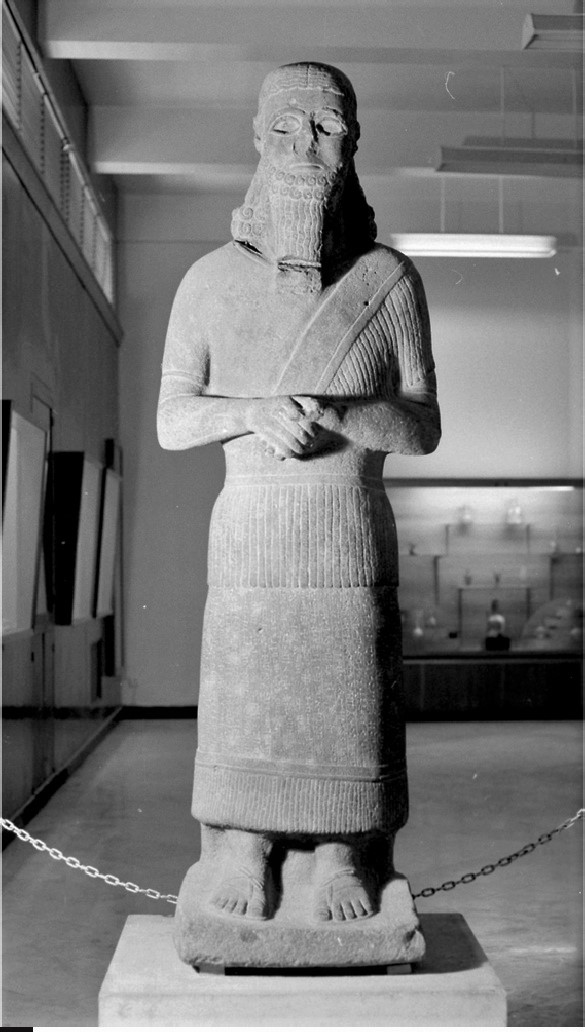
One statue, two languagesStatue of Hadad-yith'i, a local ruler, from Tell Fekheriye in north-eastern Syria, 9th century BCE. Its inscription is written twice: in Akkadian cuneiform on the front and in Aramaic letters on the back. National Museum of Damascus. Wayne Pitard · CC0
Assyrians today
The empire ended, but the people did not. Today's Assyrians are a living community who speak modern forms of Aramaic (often called Sureth or Assyrian) and are mostly Christian. Many live in northern Iraq, including the Nineveh Plains and Duhok, and in Syria, Iran and Turkey, with large communities overseas, including in Sydney and Melbourne. Like the rest of this ancient heritage, the Assyrian past belongs to all Iraqis: Arab, Assyrian, Kurdish, Mandaean, Yazidi and others. Find out more on Then & Now, including how Iraqi archaeologists are repairing Nimrud and Nineveh after damage in 2015.
Ashurnasirpal II's palace reliefs and lamassu
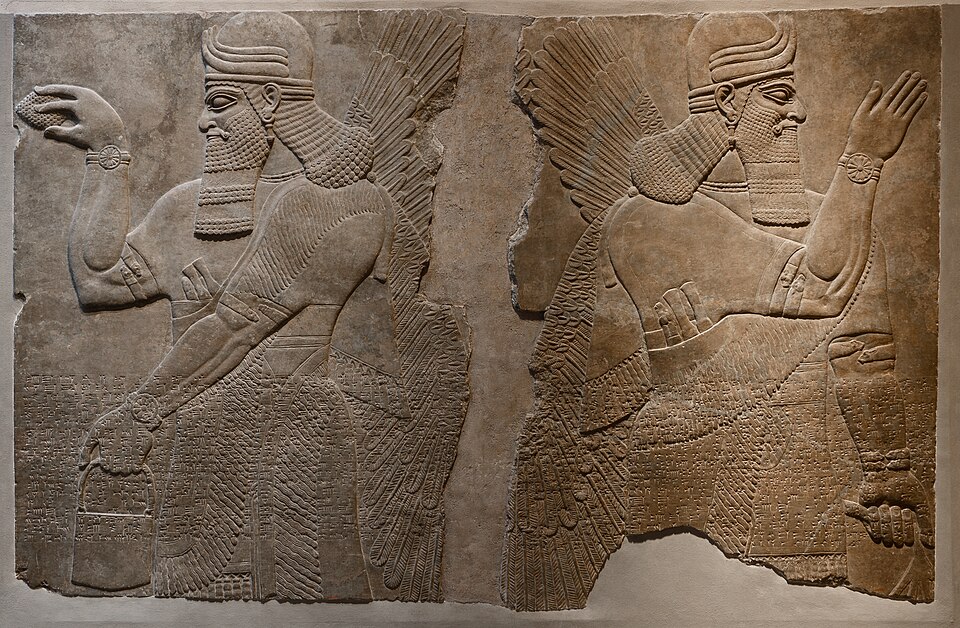
Nimrud's palace, in New YorkLamassu and wall panels from the Northwest Palace at Nimrud, 883 to 859 BCE, displayed at the Metropolitan Museum of Art. PierreSelim · Public domain
Origin
Carved for Ashurnasirpal II's Northwest Palace at Nimrud, 883 to 859 BCE. Excavated from 1845 by Austen Henry Layard and shipped to museums in London, New York and elsewhere. Others stayed at Nimrud, some damaged in 2015.
Purpose
To protect the palace with magic spirits, and to impress and intimidate visitors, including foreign ambassadors, with the king's power and piety.
What it shows
Lamassu guarding doorways, winged protective spirits (apkallu) holding a cone and bucket, and the king himself. Across every panel runs the "Standard Inscription", listing the king's titles and victories.
How useful?
Very useful for Assyrian religion, royal clothing, craftsmanship and how kings wanted to be seen. Limits: it is official royal art, so it shows only the king's point of view; the panels were removed from their rooms, so we lose some of their original setting; and the paint that once coloured them has mostly worn away.
Early dates are estimates; scholars disagree by up to about 60 years. Neo-Assyrian dates (from 911 BCE) are exact.
Dig deeper
Why are Neo-Assyrian dates so precise?
Each year in Assyria was named after an official called the limmu. Lists of these officials, with notes on events, survive for centuries. One entry records a solar eclipse that astronomers date to 15 June 763 BCE. Counting backwards and forwards from it gives exact dates from 911 BCE onward. See eponym dating. Earlier dates, including the Old Assyrian period, still depend on which chronology you follow.
How brutal was Assyria, really?
Bustenay Oded's study Mass Deportations and Deportees in the Neo-Assyrian Empire (1979) estimated that several million people were moved over about three centuries, though that figure depends on royal inscriptions that liked big numbers. Historians such as Mario Liverani and Karen Radner stress that Assyrian violence was partly ideology: kings presented war as restoring cosmic order for the god Ashur. Deportees were often resettled as farmers, soldiers or skilled workers rather than enslaved, and some rose to high office. None of this makes the suffering less real; it helps explain why the empire acted as it did.
Reading the reliefs as sources
Palace reliefs were seen by a limited audience: courtiers, officials and visiting envoys. Some scholars (for example John Malcolm Russell, in Sennacherib's Palace without Rival at Nineveh) analyse how their placement in specific rooms told a story to that audience. Compare a relief with a royal inscription describing the same campaign and with an outside source, such as the account of Sennacherib's campaign in the Hebrew Bible, and you can practise corroboration.
The library and Gilgamesh
The "Standard Babylonian" version of Gilgamesh is credited by later tradition to a scholar named Sin-leqi-unninni. Ashurbanipal's library copies are our best source for it, but new fragments keep appearing, such as a tablet acquired by the Sulaymaniyah Museum in Iraq in 2011 that added new lines to Tablet 5. See the Library of Ashurbanipal, the Gilgamesh flood myth, and Hormuzd Rassam, the Assyrian archaeologist from Mosul whose discoveries are often credited to others.
Further reading
Oracc: online editions of Assyrian royal inscriptions and letters.
Lamassu, an overview with examples in museums worldwide.
Eckart Frahm (ed.), A Companion to Assyria (2017); Eckart Frahm, Assyria: The Rise and Fall of the World's First Empire (2023), which argues for Assyria's claim to that title.
Karen Radner, Ancient Assyria: A Very Short Introduction (2015).