SumerAkkadBabylonAssyria c. 3000 BCE to 600 BCE · all of Mesopotamia
Everyday life: a day in the land between the rivers
Kings and empires get the headlines, but clay tablets also tell us what people ate, what they wore, how children were taught, how doctors worked, and even what made a customer angry.
The short version
Most people in Mesopotamia were farmers. They lived in mud-brick houses built around an open courtyard, and on hot nights they slept on the flat roof.
They ate bread, barley porridge, onions, dates and fish, and drank thick beer through straws. The oldest recipes ever found were written on clay tablets about 3,700 to 3,750 years ago.
Some children, mostly boys, went to school in the edubba, the "tablet house". They copied signs onto clay, got told off for messy writing, and sometimes tried to get out of trouble. You would fit right in.
Grown-ups worked as farmers, builders, weavers, brewers, scribes and traders. Instead of coins they paid with silver weighed on scales, or with barley. One man was so annoyed about some bad copper that he wrote the oldest known customer complaint.
For fun, people played board games and made music. When they got sick, they visited two kinds of healer: one who used medicines and one who said prayers and spells.
Homes and families
Wood and stone were rare in southern Iraq, but mud was everywhere. People mixed it with straw, shaped it into bricks and dried them in the sun. A typical town house had rooms arranged around a small open courtyard, which let in light and air and kept the rooms cooler. Windows were small and few, to keep out heat and dust. Stairs led up to a flat roof, a handy place to dry food, work and sleep in summer.
At Ur, archaeologist Leonard Woolley dug up a whole neighbourhood from about 1900 to 1750 BCE, with narrow winding lanes, shops, and houses of two storeys. Families often buried their dead under the floor of the house, so the ancestors stayed at home.
A day started at sunrise. Women and girls ground barley into flour on a stone, baked flat bread in a round clay oven called a tinūru (a lot like the tannour still used in Iraq), fetched water and spun and wove wool. Men and boys went to the fields, the canals or a workshop. The main meal came in the cooler evening.
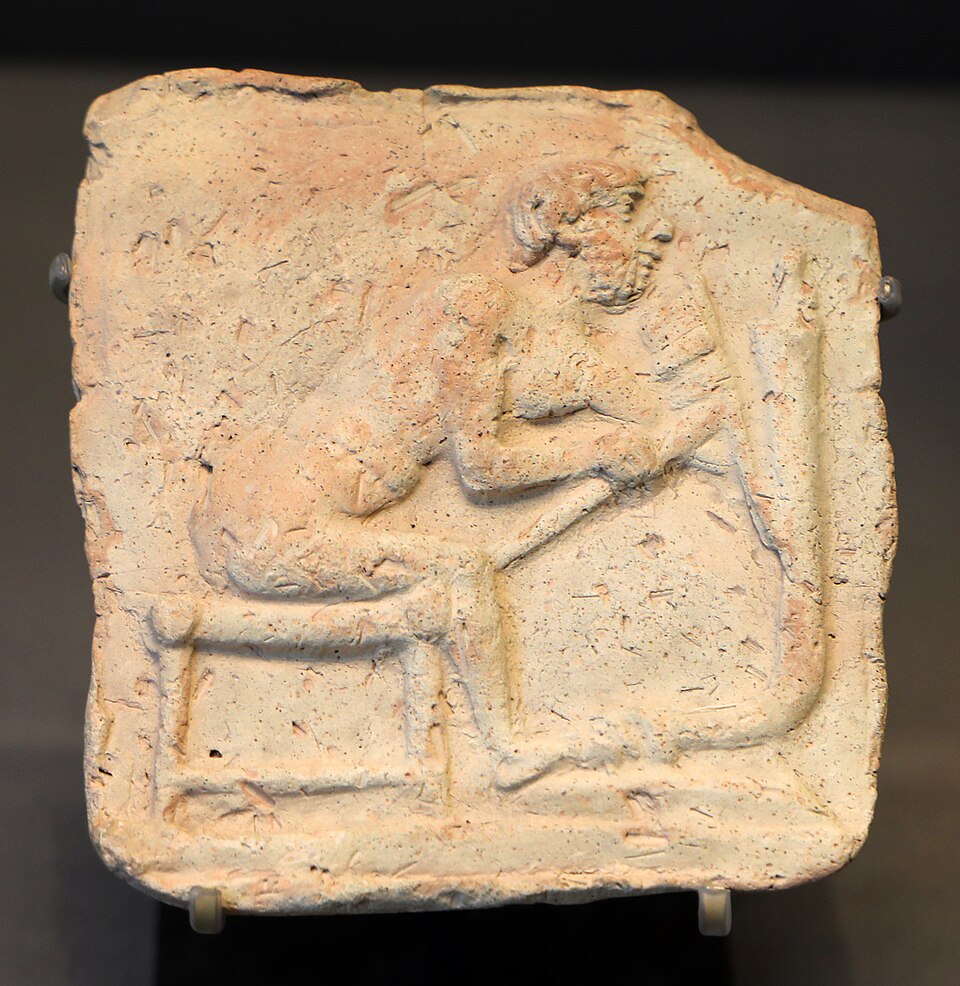
A craftsman at workMoulded clay plaque of a man carving the pole of a cart, c. 2000 to 1760 BCE, from Uruk. Louvre Museum, Paris. Francesco Bini · CC BY-SA 4.0
Food and drink
Barley, the big one
Barley grew well in salty, irrigated soil, so it became bread, porridge and beer. Workers were often paid in barley rations, so a bowl of grain was food and wages at the same time.
On the table
Flat bread, lentils, chickpeas, onions, leeks, garlic, cucumbers, dates, figs and pomegranates. Fish came from the rivers and marshes. Meat (mutton, goat, duck) was mostly for feasts and the rich.
Beer through a straw
Mesopotamian beer was thick and cloudy, with husks floating on top. People sipped it through long straws, sometimes from one shared jar. A Sumerian hymn praises Ninkasi, the goddess of brewing.
c. 1750 to 1730
BCE is roughly the date range for the Yale culinary tablets, the oldest known written recipes. The best-preserved tablet lists about 25 stews and broths, many with lamb, leeks, garlic and onion. Food historians have cooked them, and they are said to taste good.
School: the edubba 𒂍𒁾𒁀
This website is named after the Sumerian school, the é-dub-ba or "tablet house". Pupils, mostly boys from families who could afford it, arrived at sunrise with a packed lunch. The head teacher was called the ummia, and an older student, the "big brother", wrote out model lines for younger pupils to copy.
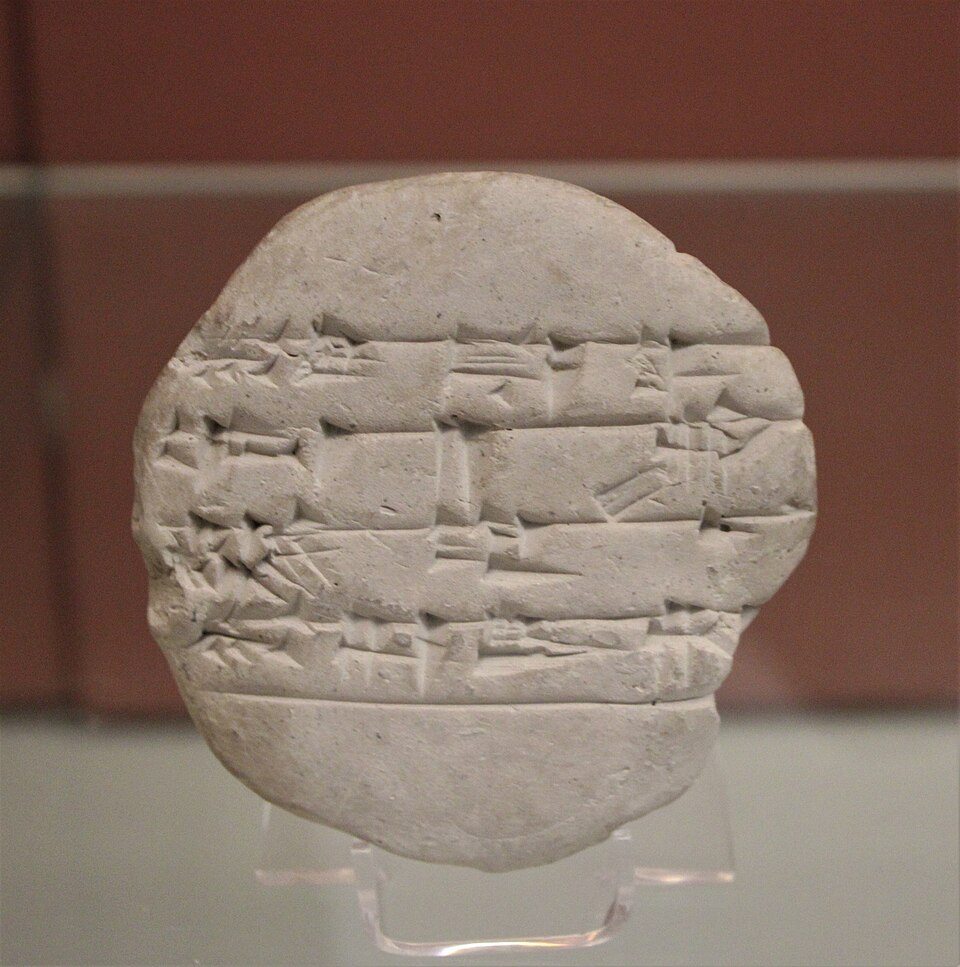
Lessons began with single wedges, then signs, then long lists of words (trees, fish, gods, jobs), then maths, measuring and proverbs. Pupils often copied the teacher's line on one side of a small round tablet and their own attempt on the back, then smoothed the clay and started again.
A Sumerian story nicknamed "Schooldays" follows one pupil through a bad day. He is late, he talks in class, he leaves the building without permission and his handwriting is messy, and different staff members punish him for each mistake. His clever fix: he asks his father to invite the teacher home for dinner and give him a present. Suddenly the teacher has only nice things to say about him.
You'd fit right in: early starts, homework, a strict teacher, worrying about neat writing, and a kid trying to charm his way out of trouble. Four thousand years later, school still sounds familiar.
Homework in clayA round school tablet with a proverb: the teacher's model on one side, the pupil's copy on the other. Old Babylonian period, c. 1900 to 1600 BCE. British Museum. Zunkir · CC BY-SA 4.0
Work and money
Almost everything depended on irrigation. Farmers dug and cleaned canals that carried water from the Tigris and Euphrates to fields of barley and wheat, and to groves of date palms. Around them worked potters, weavers, brewers, bakers, carpenters, metalworkers, boat builders and herders. Scribes kept the records that held it all together.
There were no coins until much later. Prices were set in silver, weighed out on scales in units called the shekel (about 8 grams) and the mina (60 shekels, about half a kilogram). Everyday payments were often made in barley instead. Standard stone weights, often shaped like ducks, helped keep trade fair, though some people were caught using false ones.
Merchants travelled by donkey caravan and by boat, swapping grain, textiles and dates for things Mesopotamia lacked: copper, tin, timber, and lapis lazuli from as far away as Afghanistan.
The complaint tablet to Ea-nasir
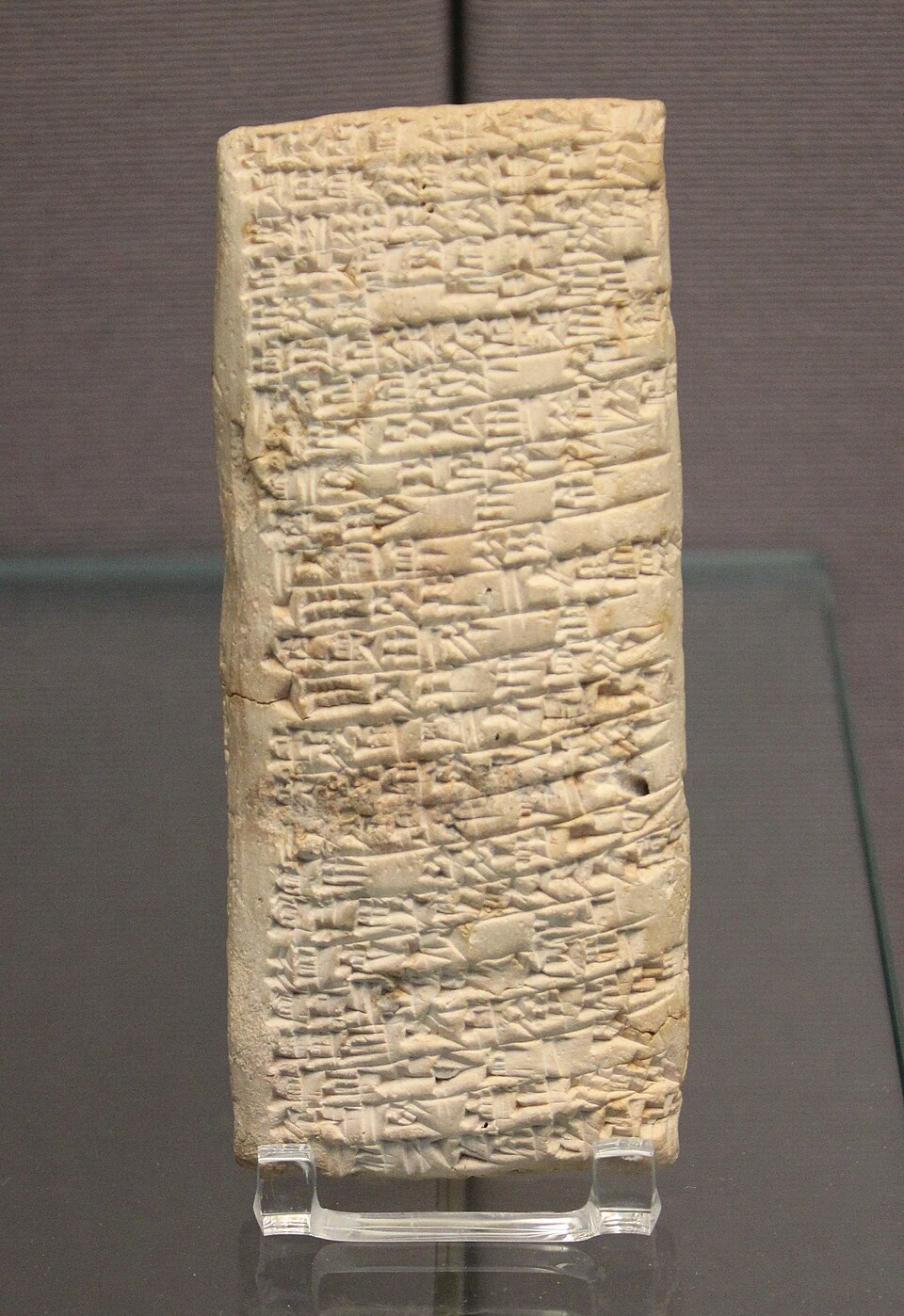
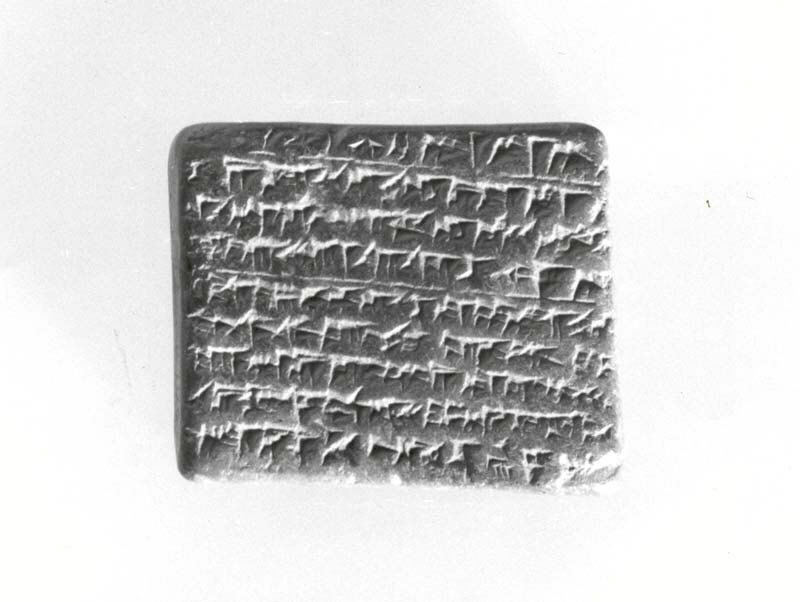
The oldest complaint letterA letter from Nanni to the copper merchant Ea-nasir, c. 1750 BCE, from Ur. British Museum (BM 131236). Zunkir · CC BY-SA 4.0
Origin
Found at Ur during Leonard Woolley's excavations (1922 to 1934), in a house that probably belonged to Ea-nasir himself. It dates from about 1750 BCE, when Ur was ruled first by Larsa and then by Babylon.
Purpose
A business letter. A man called Nanni had paid for copper ingots, and he is furious that Ea-nasir sent poor-quality metal and was rude to his messenger.
What it says
Nanni asks, in effect, "How dare you treat me with such contempt?" He says his messengers were sent home empty-handed through enemy country, and he demands his silver back. It is often called the oldest known customer complaint.
How useful?
Very useful for trade, money and how people actually wrote to each other. Other tablets from the same house suggest Ea-nasir had more unhappy customers. Limits: we only hear Nanni's side, and we do not know how the argument ended.
Games and music
The Royal Game of Ur
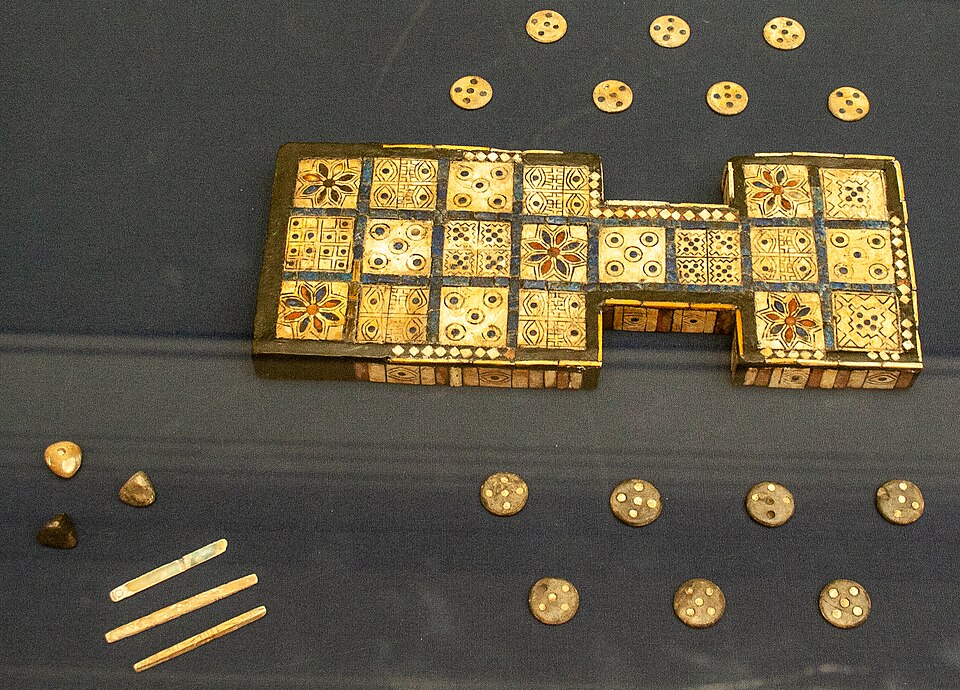
Woolley found several game boards in the Royal Cemetery of Ur, dating to about 2600 to 2400 BCE. Each has 20 squares, decorated with shell and lapis lazuli, and is played with counters and pyramid-shaped dice. Versions of the game were played across the Middle East for more than 2,000 years.
How do we know the rules? Irving Finkel, a curator at the British Museum, worked them out from a tablet written by a Babylonian scribe in 177 BCE, more than 2,000 years after the Ur boards were made. So the rules we play today are a careful reconstruction, not a rulebook from Ur itself.
Music
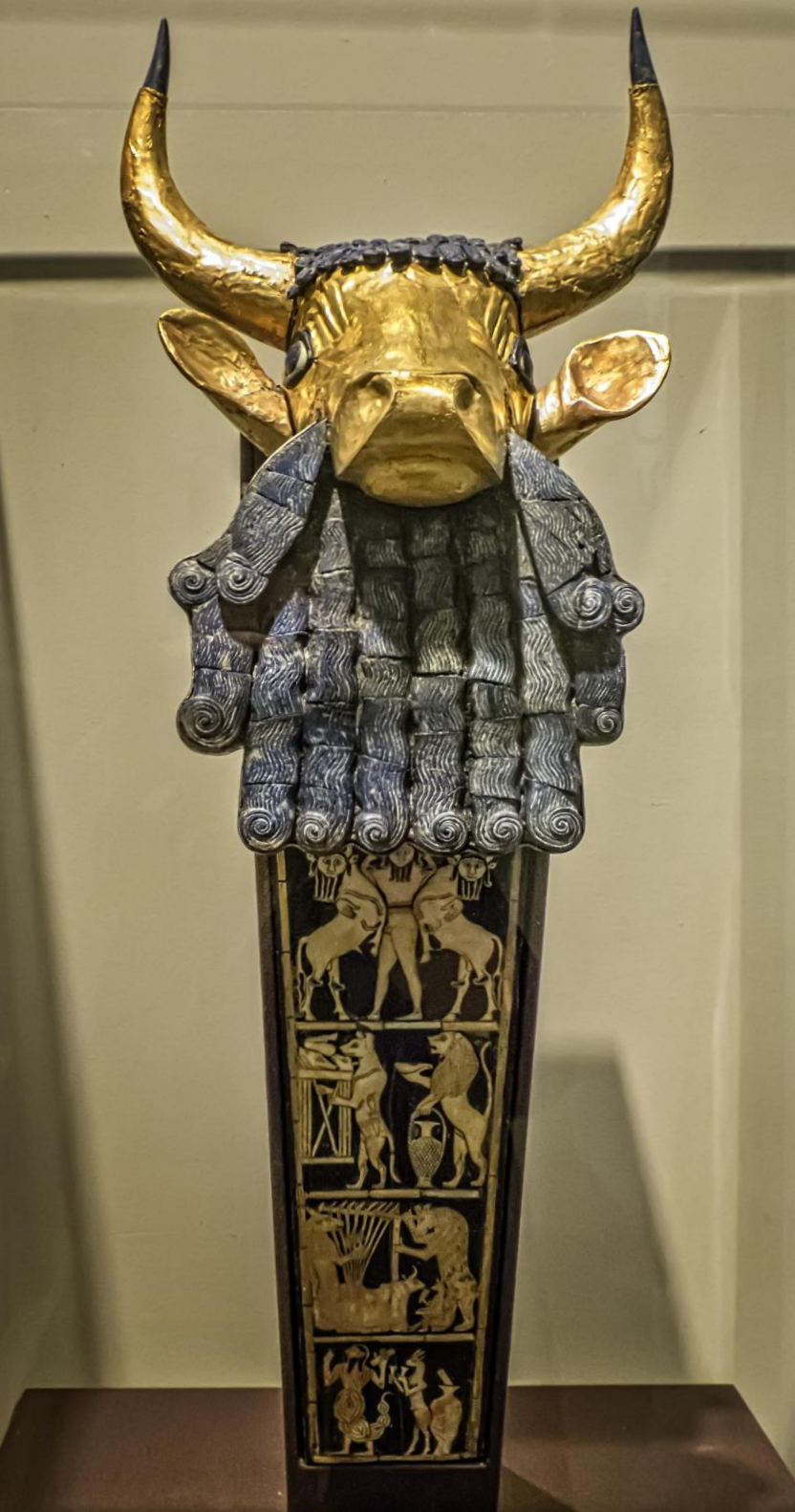
Music was everywhere: at temples, feasts and funerals. The Royal Cemetery also held beautiful lyres, harp-like instruments with a sound box decorated with a bull's head in gold and lapis lazuli. Three famous examples are in the Iraq Museum in Baghdad, the British Museum and the Penn Museum in Philadelphia. The one in Baghdad was damaged during the 2003 looting and later restored by Iraqi conservators.
The oldest substantially preserved melody, the Hurrian hymn, was written on a clay tablet around 1400 BCE. It was found at Ugarit on the coast of Syria, so it comes from outside Mesopotamia, but it uses Babylonian music terms written in cuneiform, which shows how far Mesopotamian learning had spread.
The bull-headed lyreLyre from the Royal Cemetery of Ur, c. 2550 to 2450 BCE, gold, lapis lazuli and shell (the wooden parts are modern). Penn Museum, Philadelphia. Mary Harrsch · CC BY 2.0
The Royal Game of Ur
A 4,500-year-old board gameGame board from grave PG 513 at Ur, c. 2600 to 2400 BCE. British Museum. Szilas · CC BY-SA 4.0
Origin
Excavated by Leonard Woolley at the Royal Cemetery of Ur in the 1920s. Wood with inlays of shell, red limestone and lapis lazuli. The wood had rotted and was rebuilt for display.
Purpose
A race game for two players. It was buried with an important person, which suggests it was treasured, and perhaps meant for play in the afterlife.
What it shows
Twenty squares, with five rosettes. In Finkel's version, landing on a rosette is lucky and gives you another turn. The same board layout turns up from Iran to Egypt, and even scratched onto a stone lamassu at Khorsabad, so guards in Assyria may have played it on duty.
How useful?
Great evidence that people played for fun and that games spread through trade. Limits: the rules come from a tablet written 2,000 years later, and rules can change a lot in that time.
Women's lives
Mesopotamia was run mostly by men, and most women's lives centred on family, food and cloth. But tablets show many women with real power, property and voices of their own.
Priestesses
Some women held high religious office. The most famous is Enheduanna, daughter of Sargon of Akkad and high priestess at Ur, the earliest author in history whose name we know.
The naditu of Sippar
In the Old Babylonian city of Sippar (c. 1880 to 1550 BCE), women called naditu lived in a walled community dedicated to the sun god Shamash. They did not have children, but they bought and rented out land, lent silver and signed contracts. Their records survive in their hundreds.
In Hammurabi's laws
Hammurabi's laws (c. 1754 BCE) protected a wife's dowry, let some women divorce and keep property, and mention women who ran taverns. The laws still treated men and women unequally.
Letters from Assur
In the Old Assyrian period (c. 1950 to 1750 BCE), merchants traded far away at Kanesh in Turkey. Their wives back in Assur wove cloth for export, managed money and wrote letters, sometimes telling their husbands off for not writing home.
Medicine: going to the doctor
Mesopotamians believed illness could have natural causes and could also come from angry gods, demons or a person's wrongdoing. So there were two kinds of healer, and they often worked together.
The asû (say "AH-soo") was the practical physician. He made medicines from plants and minerals, cleaned and bandaged wounds, and applied poultices (warm pastes on the skin).
The āšipu (say "AH-shi-poo") was an expert in diagnosis and ritual. He examined the patient, worked out which god or spirit might be behind the illness, predicted what would happen, and recited incantations (healing prayers) to drive it out.
Medicines included herbs and plants such as thyme, mustard, liquorice, myrrh, willow, and juniper, plus salt and other minerals. They were mixed into beer, milk, oil or honey, rubbed on as ointments, or breathed in as smoke.
Around 1050 BCE, a Babylonian scholar called Esagil-kin-apli is said to have put together the Diagnostic Handbook, known as Sakikku ("symptoms"). Its 40 tablets list symptoms from head to toe and say what they might mean, and whether the patient is likely to get better.
Hammurabi's laws even set doctors' fees. A successful operation on a wealthy patient cost 10 shekels of silver, a poorer man paid 5, and an enslaved person's owner paid 2. The same laws set harsh penalties for a surgeon whose operation went badly wrong.
A doctor's notesFragment of an Assyrian medical text, c. 900 to 600 BCE. Metropolitan Museum of Art, New York. Metropolitan Museum of Art · CC0
GP
Then and now. A modern GP takes your history, examines you, makes a diagnosis, tells you what is likely to happen and prescribes treatment. The Diagnostic Handbook follows the same steps: symptoms, a head-to-toe examination, a likely outcome and a remedy. The big difference: today's doctors rely on tested evidence, not omens and spells. Oh, and the rebates are set by Medicare, not by a king.
Clothing, hair and jewellery
Mesopotamia ran on sheep, and most clothes were wool, with finer linen for priests and the wealthy. Weaving was one of the biggest industries, with temples and palaces employing thousands of women weavers.
In early Sumer, statues show men and women in the kaunakes, a skirt or cloak covered in tufts or flounces of wool that looks a bit like a sheepskin. Later, people wore long wrapped and fringed garments. Men's beards were a mark of dignity, and Assyrian kings are shown with long, carefully curled beards and hair.
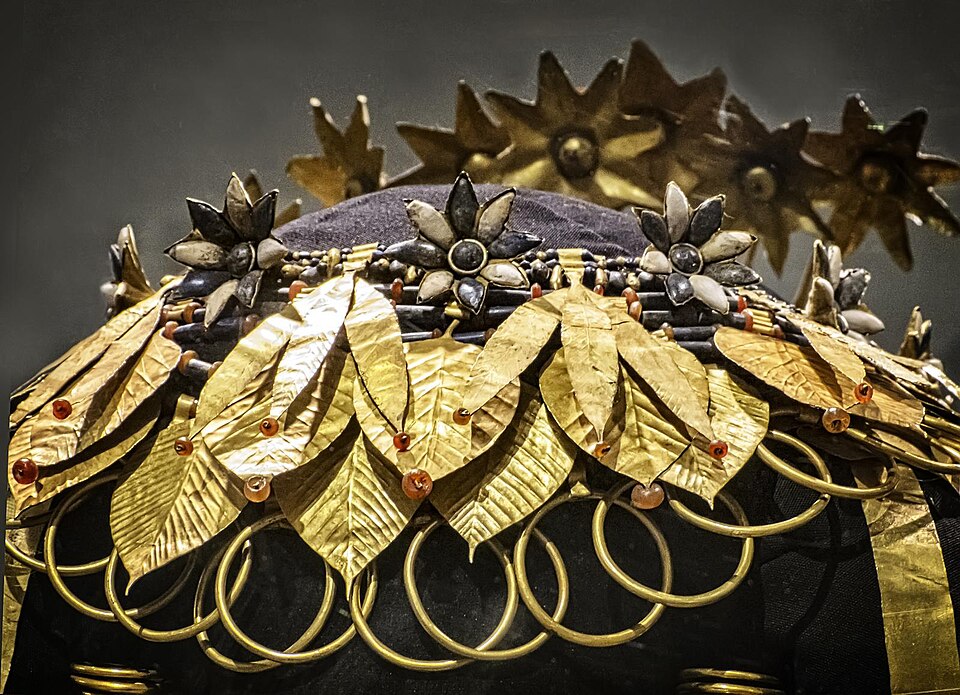
Jewellery was for everyone who could afford it: beads of carnelian and lapis lazuli, gold earrings, and pins to fasten cloaks. The richest example of all comes from the tomb of Queen Puabi at Ur (c. 2600 to 2450 BCE): a headdress of gold leaves, rings and flowers, with strings of lapis lazuli and carnelian beads.
Queen Puabi's headdressGold, lapis lazuli and carnelian, from the Royal Cemetery of Ur, c. 2550 to 2450 BCE. Penn Museum, Philadelphia. Mary Harrsch · CC BY 2.0
Early dates are estimates; scholars disagree by up to about 60 years. We put "c." (short for circa, "about") in front of them.
Dig deeper
Houses and the evidence for daily life
Most of what we know about ordinary homes comes from a few well-dug neighbourhoods: the Old Babylonian quarter at Ur, and houses at Nippur, Larsa and Mashkan-shapir. Woolley gave Ur's lanes playful English names; one house he called "No. 1 Broad Street" held many school tablets, and Woolley thought it was a small school run from a home. Scholars still debate whether the tablets really belong to that house. Archaeologists today stress that houses changed size as families grew and split, which we can trace through sale and inheritance contracts.
The Yale culinary tablets
Three tablets in the Yale Babylonian Collection (YBC 4644, 4648 and 8958), written in Akkadian around 1750 to 1730 BCE (sources differ), are the oldest recipes known. They read like notes for experienced cooks, with ingredients but few quantities or times. The Assyriologist Jean Bottéro first studied them in detail; more recently a team including Gojko Barjamovic and Agnete Lassen has cooked and published them.
School texts
"Schooldays" is known to scholars as Edubba A. It survives in many copies, because pupils copied stories about school as part of their lessons, which is a lovely joke in itself. Other school texts include debates between pupils and teachers. Read them in translation at the Electronic Text Corpus of Sumerian Literature.
Medicine in more detail
The Sakikku (written SA.GIG) was edited by Esagil-kin-apli of Borsippa, a scholar under King Adad-apla-iddina (reigned about 1067 to 1046 BCE; sources differ by a few years). Its tablets are organised from head to foot and then by illness and by patient group, including a section on pregnancy and babies. Entries follow an "if ... then" pattern: if the patient shows a certain sign, then a certain outcome follows. Historians debate how far the asû and āšipu were separate jobs; many patients probably saw both. Treatment texts, such as those found in Ashurbanipal's library at Nineveh and in a family archive at Assur, list hundreds of plant and mineral ingredients, though many names are still hard to identify.
Hammurabi's laws §215 to 217 set the fee for a successful operation with a bronze lancet according to the patient's rank: 10 shekels for an awīlum (a free man of high status), 5 for a muškēnum (a commoner) and 2 for an enslaved person, paid by the owner. §218 says that if the patient died or lost an eye, the surgeon's hand was to be cut off. Historians are not sure how often laws like this were actually applied; Hammurabi's "code" may have been more about showing the king as just than a rulebook for the courts.
Women's archives
Rivkah Harris's work on Old Babylonian Sippar described the naditu in detail: many came from wealthy families, entered the gagûm (cloister) young, and managed property for decades. At Kanesh (modern Kültepe in Turkey), archaeologists have found over 20,000 Old Assyrian tablets, including letters by women such as Lamassi to her husband Pushu-ken. Cécile Michel's book Women of Assur and Kanesh (2020) translates many of them.
Music and the Hurrian hymn
The Hurrian hymn (known as h.6) is a song to the goddess Nikkal, written in the Hurrian language with instructions in Babylonian musical terms. Scholars agree it gives the intervals to play on a lyre, but disagree on how to read them, so modern performances sound quite different from each other.
Books: Karen Rhea Nemet-Nejat, Daily Life in Ancient Mesopotamia; JoAnn Scurlock and Burton Andersen, Diagnoses in Assyrian and Babylonian Medicine; Jean Bottéro, The Oldest Cuisine in the World.