A king who said he was found floating in a basket, a priestess who signed her poems, and a city so thoroughly lost that nobody has found it yet.
The short version
For hundreds of years the cities of Sumer each had their own king. Then, around 2334 BCE, a man called Sargon conquered them all and joined them into one kingdom. He went on to rule lands from the Persian Gulf towards the Mediterranean. That makes his kingdom, Akkad, the first empire: one ruler in charge of many different peoples and cities.
The people of Akkad spoke Akkadian, a language related to Arabic, Hebrew and Aramaic. They wrote it in the same cuneiform signs as the Sumerians.
Sargon's daughter Enheduanna became a high priestess and wrote hymns. She is the first author in history whose name we know.
His grandson Naram-Sin was so proud he called himself a god. About 180 years after it began, the empire fell apart. Its capital city, Akkad, has never been found.
Where in the worldAkkad's heartland was in central Iraq, near modern Baghdad. The capital has never been found, so its dot has a question mark. The dashed line shows roughly how far the empire reached under Naram-Sin, c. 2250 BCE. See the full map. Mesopotamia guide · modern borders and rivers, simplified
Sargon: from a basket to a throne
Sargon (in Akkadian, Sharru-kin, "the true king") ruled for about 56 years, roughly c. 2334 to 2279 BCE. Those dates are not secure: they are worked out from later king lists and could be off by decades.
A famous story about him, written down more than a thousand years later, says his mother was a priestess who secretly placed her baby in a basket of reeds sealed with tar and set it on the Euphrates. A water-drawer named Aqqi fished him out and raised him as a gardener, and the goddess Ishtar loved him and made him king.
Historians treat this as a legend. What later texts agree on is that Sargon began as a cup-bearer (a trusted royal servant) to the king of Kish, took power, built a new capital called Akkad, and won battle after battle. His inscriptions boast that 5,400 men ate before him every day, which tells you he wanted to look powerful.
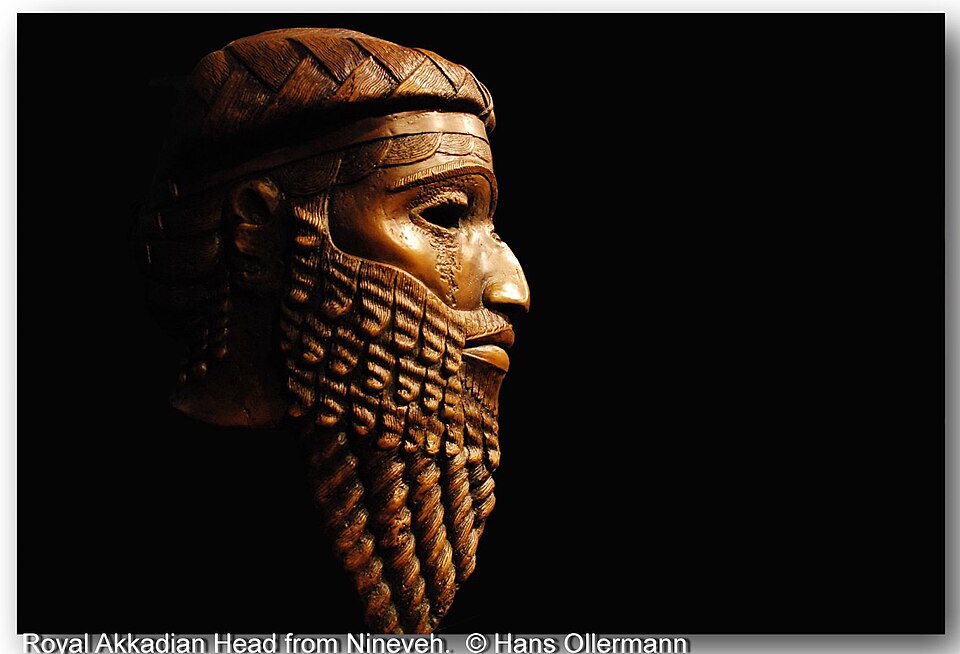
A king in bronzeA bronze head of an Akkadian king, found at Nineveh in 1931. It may show Sargon or Naram-Sin; nobody knows for sure. Iraq Museum, Baghdad (inv. IM 11331). Hans Ollermann · CC BY-SA 2.0
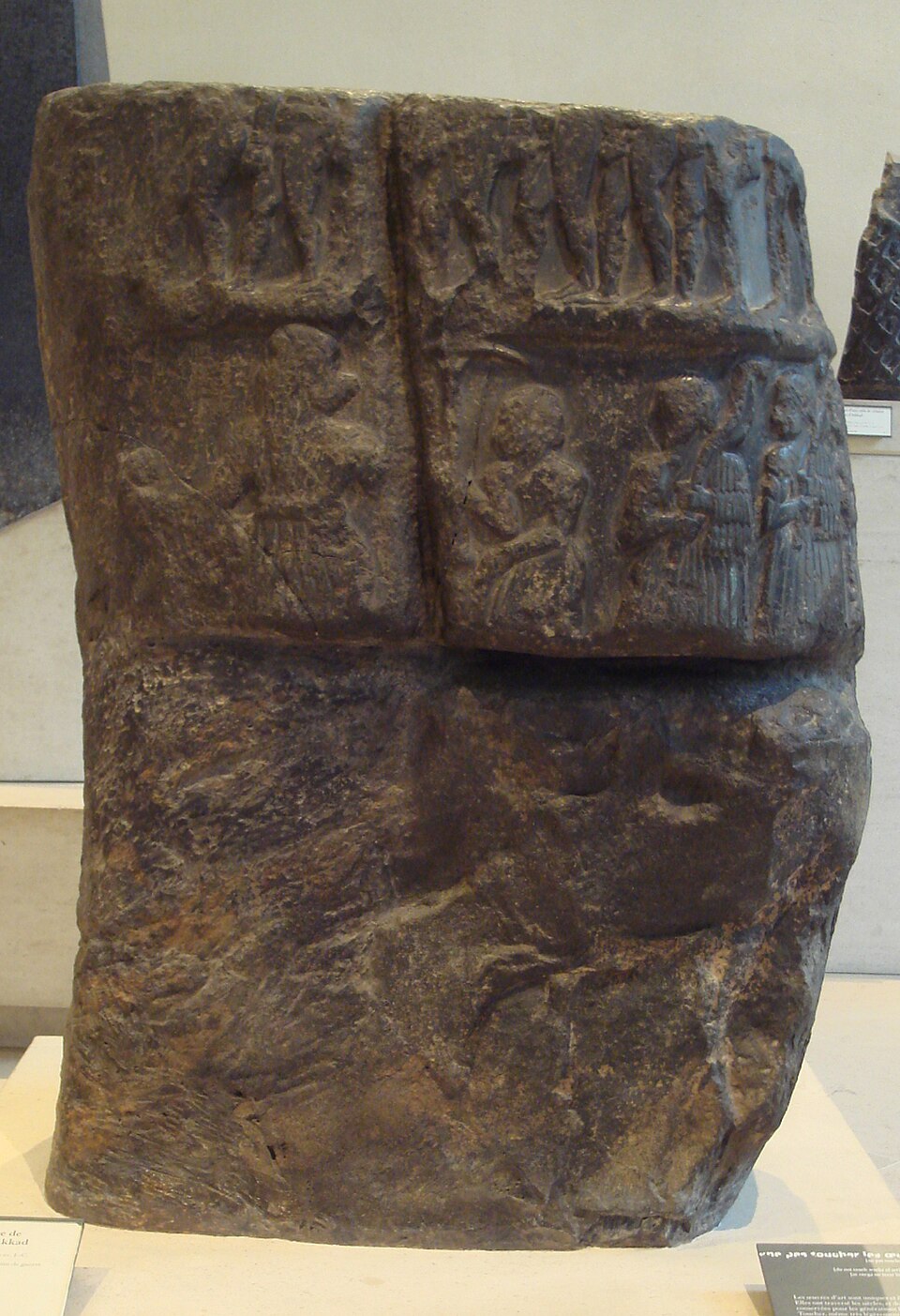
Sargon's victory steleA broken piece of a victory monument of Sargon, c. 2300 BCE, carved in hard dark stone. Like Naram-Sin's stele, it was carried off to Susa in Iran centuries later, where it was dug up. Louvre Museum, Paris. ALFGRN · CC BY-SA 2.0
Enheduanna: the first named author
Sargon made his daughter Enheduanna (c. 2285 to 2250 BCE) the high priestess of the moon god Nanna at Ur, in the heart of Sumer. It was a clever move: a member of the new royal family now led one of the oldest temples in the land.
Enheduanna is credited with a set of hymns to the temples of Sumer and with poems to the goddess Inanna, including The Exaltation of Inanna. In it she speaks in her own voice, describing being forced out of her temple by a rebel and asking Inanna to restore her. That makes her the earliest author, of any gender, whose name we know.
Her poems were copied by students in tablet houses for centuries, so she became part of the school reading list of the ancient world.
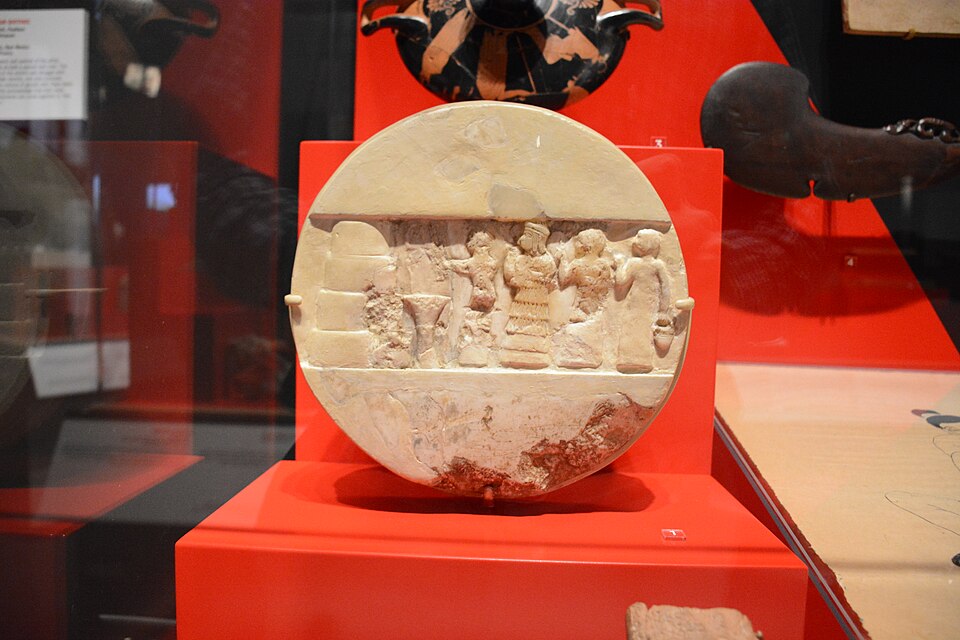
The Disk of EnheduannaThe Disk of Enheduanna, found at Ur by Leonard Woolley. She is the figure in the long flounced robe. Penn Museum, Philadelphia. Mefman00 · CC0
Naram-Sin: "king of the four quarters"
Sargon's grandson Naram-Sin (c. 2254 to 2218 BCE) put down a great revolt and pushed the empire's borders further. He took a new title, "king of the four quarters" (meaning the whole world), and was the first Mesopotamian king to write his name with the sign for "god" in front of it. To some people at the time, that probably looked like a step too far.
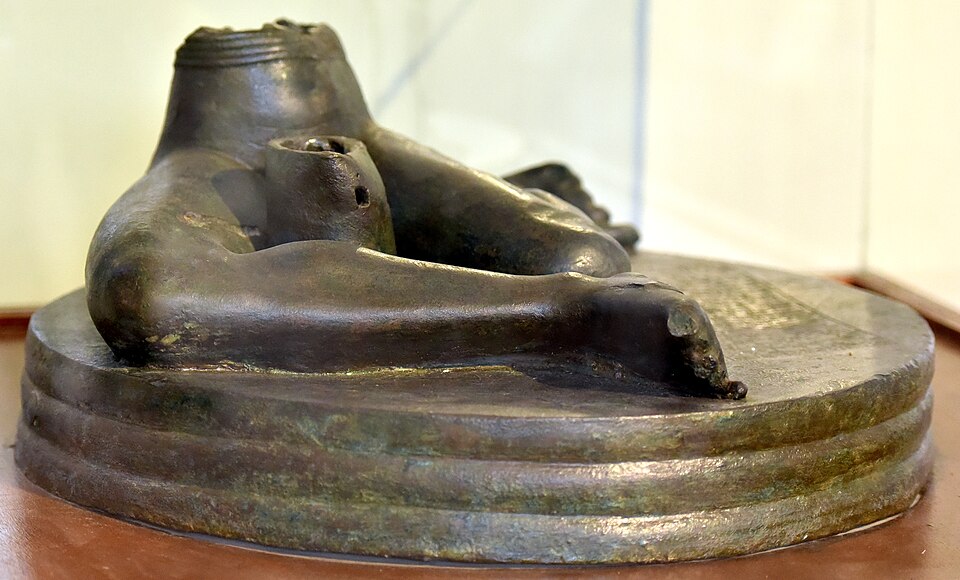
We know this partly from a statue found far from Akkad. In 1975, workers at Bassetki, in Duhok Province in the north of Iraq, dug up the bottom half of a heavy copper statue. Its inscription says that after Naram-Sin won nine battles in a single year, the people of Akkad asked the gods to make him the god of their city, and built him a temple.
The Bassetki StatueCopper statue base, 23rd century BCE, found at Bassetki, northern Iraq. Looted from the Iraq Museum in 2003, it was tracked down and returned the same year. Iraq Museum, Baghdad. Osama Shukir Muhammed Amin FRCP(Glasg) · CC BY-SA 4.0
What Akkad changed
The first empire
Akkad covered an estimated 650,000 square kilometres and ruled many peoples: Sumerians, Akkadians, Elamites and hill peoples of the Zagros. Governors loyal to the king replaced local rulers.
A shared language
Akkadian became the language of government. Later, Babylonian and Assyrian were both forms of Akkadian, and for over a thousand years it was the language kings used for letters across the Middle East.
Standard measures
The kings of Akkad promoted standard weights and measures for grain and silver, so taxes and trade worked the same way across the empire.
New art
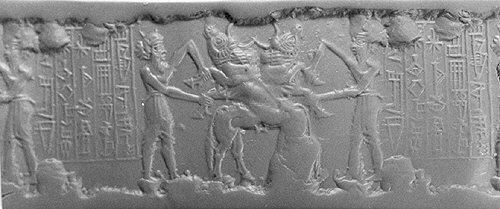
Akkadian artists made livelier, more realistic sculpture and some of the finest cylinder seals ever carved, full of gods, heroes and animals in motion.
A seal in actionModern impression rolled from an Akkadian cylinder seal, c. 2350 to 2150 BCE. Heroes wrestle wild animals in a "contest scene", a favourite Akkadian design. The panel of signs usually names the seal's owner. Metropolitan Museum of Art, New York. Metropolitan Museum of Art · CC0
The lost city of Akkad
Every other capital on this site can be found on a map. Akkad (also written Agade) cannot. Ancient texts describe it as a rich city with ships from distant lands tied up at its quays, but no excavation has ever identified it. Most scholars think it lies somewhere in central Iraq, perhaps near Baghdad, or between the ancient cities of Sippar and Kish, possibly buried deep under river silt. On our map it is marked with a question mark.
?
The capital of the world's first empire is still waiting to be found. One day an Iraqi archaeologist may be the person who finds it.
How the empire fell
After Naram-Sin, the empire shrank fast. By about c. 2154 BCE it had collapsed. Later texts blame the Gutians, raiders from the Zagros mountains. A Sumerian poem, The Curse of Agade, says the gods destroyed the city because Naram-Sin damaged Enlil's temple at Nippur. Some scientists add another cause: a long drought around 2200 BCE that may have ruined harvests in the north. All three ideas are still argued about.
The Victory Stele of Naram-Sin
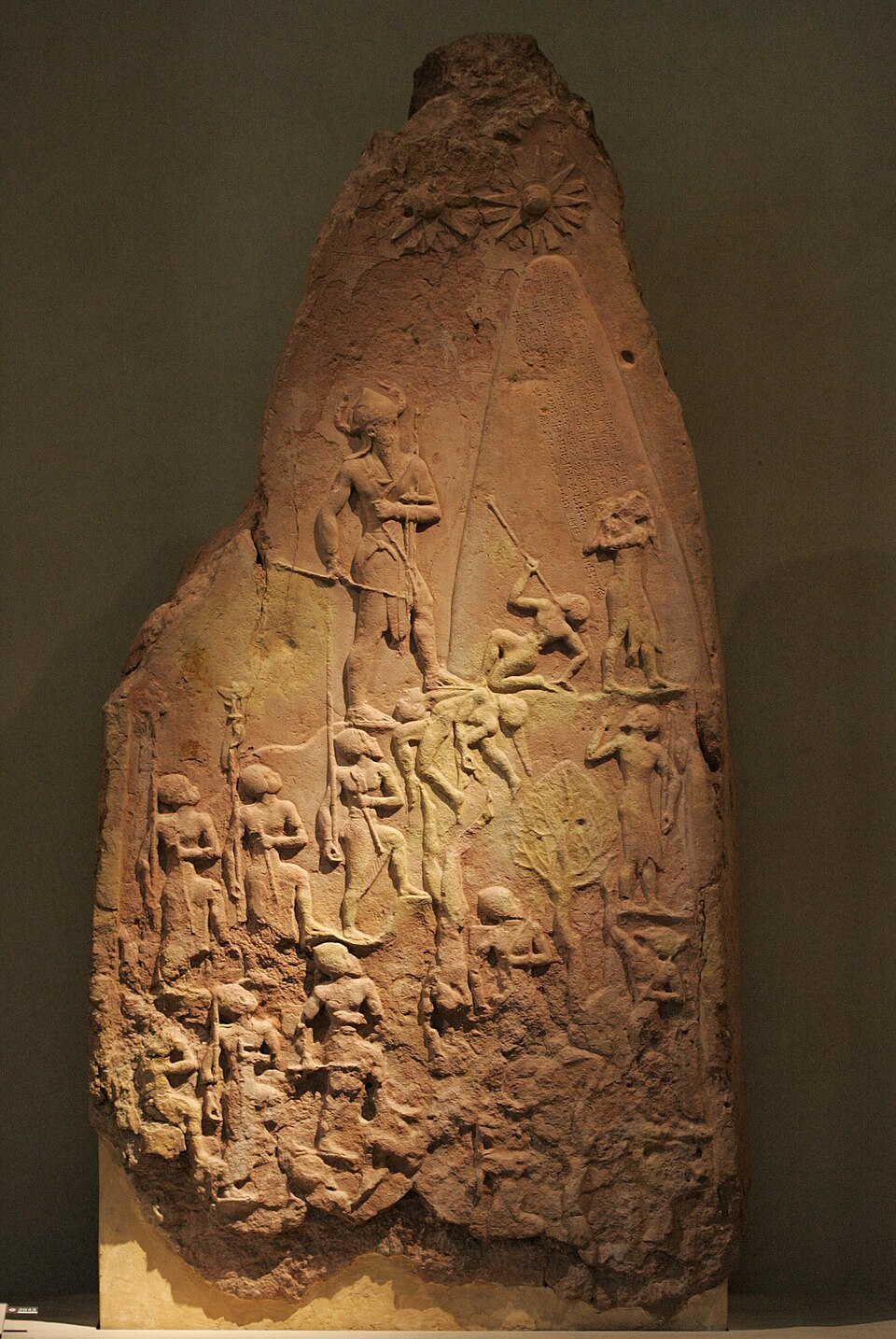
The Victory Stele of Naram-SinThe Victory Stele of Naram-Sin, c. 2250 BCE, about 2 metres tall. Louvre Museum, Paris. Rama · CC BY-SA 3.0 FR
Origin
Carved in Naram-Sin's reign to celebrate his victory over the Lullubi, a people of the Zagros mountains. About 1,000 years later, an Elamite king, Shutruk-Nahhunte, carried it off as a trophy to Susa (in modern Iran), where French archaeologists found it in 1898.
Purpose
Propaganda. It was set up in public to show that the king was unbeatable and favoured by the gods.
What it shows
Soldiers march up a mountain. The king, much bigger than everyone else, wears a horned helmet, a sign of a god. Above him shine star symbols of the gods. Defeated enemies fall or plead for mercy.
How useful?
Excellent for how Naram-Sin wanted to be seen, and for Akkadian weapons, clothing and art. Limits: it shows only the king's side; it tells us nothing about what the Lullubi thought; numbers and details of the battle are not given; and part of the top and its inscription is broken off.
Early dates are estimates; scholars disagree by up to about 60 years. We put "c." (short for circa, "about") in front of them.
Dig deeper
How do we know about Sargon at all?
Very few original Akkadian royal inscriptions survive. Most of what we read comes from copies made by Old Babylonian scribes several centuries later, who copied the inscriptions off statues at Nippur. Later still, Sargon became a hero of legend. The birth story (often called the "Sargon Birth Legend") survives on Neo-Assyrian tablets of the 7th century BCE, perhaps written in the time of the Assyrian king Sargon II, who had good reasons to glorify the first famous Sargon. So historians separate three layers: contemporary evidence, later copies, and later legend.
Did Enheduanna really write her poems?
The poems survive in copies from about 500 years after her life, and their language is Old Babylonian Sumerian. Some scholars doubt that she wrote them herself; others, such as Annette Zgoll and Betty De Shong Meador, argue that a real woman-author tradition sits behind them. Either way, ancient scribes believed she was the author, which tells us how much a woman priest-poet could be honoured. Read The Exaltation of Inana in translation (ETCSL, University of Oxford) and see the Enheduanna article.
Drought or invasion?
In 1993 Harvey Weiss and colleagues argued in the journal Science that a sudden dry period around 2200 BCE, now called the 4.2-kiloyear event, caused cities in northern Mesopotamia to be abandoned and helped bring Akkad down. Critics point out that dating the drought and the collapse precisely enough to link them is hard, and that the south kept farming with irrigation. The ancient explanation, The Cursing of Agade, was written after the fall and is a moral story, not a report.
Was it really the "first empire"?
Earlier kings, such as Lugalzagesi of Uruk, had united several Sumerian cities. What makes Akkad different is its size, its rule over many peoples and languages, and its use of governors and a standing army. Some historians prefer to call it the first "territorial state" and argue about where the line between a large kingdom and an empire lies.