SumerAkkadBabylonAssyria c. 3000 BCE to 609 BCE · gods and stories
Gods, monsters and the oldest great story
Mesopotamians shared their cities with hundreds of gods, and told stories about them that were copied onto clay for more than 2,000 years. One of them, the Epic of Gilgamesh, is still read all over the world.
The short version
People in ancient Mesopotamia believed in many gods. There was a god of the sky, a god of the wind, a goddess of love and war, a sun god who saw everything, and a moon god who sailed across the night. Each city had its own special god, who people believed lived in the big temple in the middle of town.
They told stories to explain the world. Where did the land and sky come from? Why do people die? Why do the seasons change? Their answers became myths (old sacred stories).
The most famous is the story of Gilgamesh, a proud king of Uruk, and Enkidu, a wild man who became his best friend. Together they fight a forest monster. When Enkidu dies, Gilgamesh goes looking for a way to live forever. He doesn't find it, but he learns something more useful.
These stories were written on clay tablets. Many were lost for about 2,000 years, until archaeologists dug them up and scholars learned to read them again.
The great gods 𒀭
In cuneiform, the sign 𒀭 (said "dingir") means "god". Scribes wrote it in front of a god's name, a bit like a capital letter that says "this one is divine". Most gods had a Sumerian name and a later Akkadian name, used by Akkadians, Babylonians and Assyrians.
𒀭
An / Anu
Rules: the sky, and is father of many gods. Symbol: a horned crown. City: Uruk.
The oldest and highest god, but far away. Other gods did most of the day-to-day work.
𒀭
Enlil / Ellil
Rules: wind, storms and kingship. Symbol: a horned crown. City: Nippur, temple Ekur.
The "boss" of the gods on Earth. Kings wanted his blessing to rule.
𒀭
Enki / Ea
Rules: fresh water, wisdom, magic and crafts. Symbol: streams of water with fish, and the goat-fish. City: Eridu.
The clever one, and humans' best friend among the gods. He often saves people in the stories.
𒀭
Inanna / Ishtar
Rules: love, war and the planet Venus. Symbol: an eight-pointed star, and the lion. City: Uruk, temple Eanna.
The most popular goddess of all: brave, bold and quick to anger.
𒀭
Utu / Shamash
Rules: the sun, justice and truth. Symbol: a sun disc, and a saw-toothed blade. Cities: Sippar and Larsa.
He crossed the sky every day, so he saw everything. That made him the god of fair judgement.
𒀭
Nanna / Sin
Rules: the moon and the calendar. Symbol: a crescent moon. Cities: Ur, and later Harran.
The Ziggurat of Ur was his house. Enheduanna, the earliest named author, was his high priestess.
𒀭
Ereshkigal
Rules: the Underworld, the "Great Below". Symbol: no agreed symbol; she sits on a throne in her palace. City: few temples; worshipped at Kutha beside Nergal, her husband in later myths.
Inanna's older sister. Her name means "Queen of the Great Earth". The Akkadian name stayed the same.
𒀭
Marduk Babylon
Sumerian writing: Amar-Utu, "calf of the sun". Rules: Babylon, and later all the gods. Symbol: a spade, and a snake-dragon. City: Babylon, temple Esagil.
A city god who rose to become king of the gods as Babylon grew powerful.
𒀭
Ashur Assyria
Rules: the city and land of Assyria, and its kings. Symbol: often linked with a winged disc (debated). City: Assur, temple Esharra.
The god and his city share one name. Assyrian kings saw themselves as his servants.
Gods lived in cities
To a Mesopotamian, a temple was not a place to meet on a weekend. It was the god's house. The Sumerian word for temple, é, simply means "house". The biggest temples stood on or beside a ziggurat, a stepped tower that lifted the god closer to the sky.
Inside lived the god's statue, made of precious wood, covered in gold and dressed in fine clothes. People believed the god was present in it. After a special ceremony called "washing of the mouth", the statue was treated like a living ruler: it was woken up, dressed, and "fed" two big meals a day of bread, meat, fruit and beer. After the god had "eaten", the food was shared among the priests and temple workers.
Priests and priestesses ran the temple. Some sang hymns, some read signs of the future, some looked after the statue. Most ordinary people never went inside the inner room. They prayed in courtyards, or left small statues of themselves to keep praying for them.
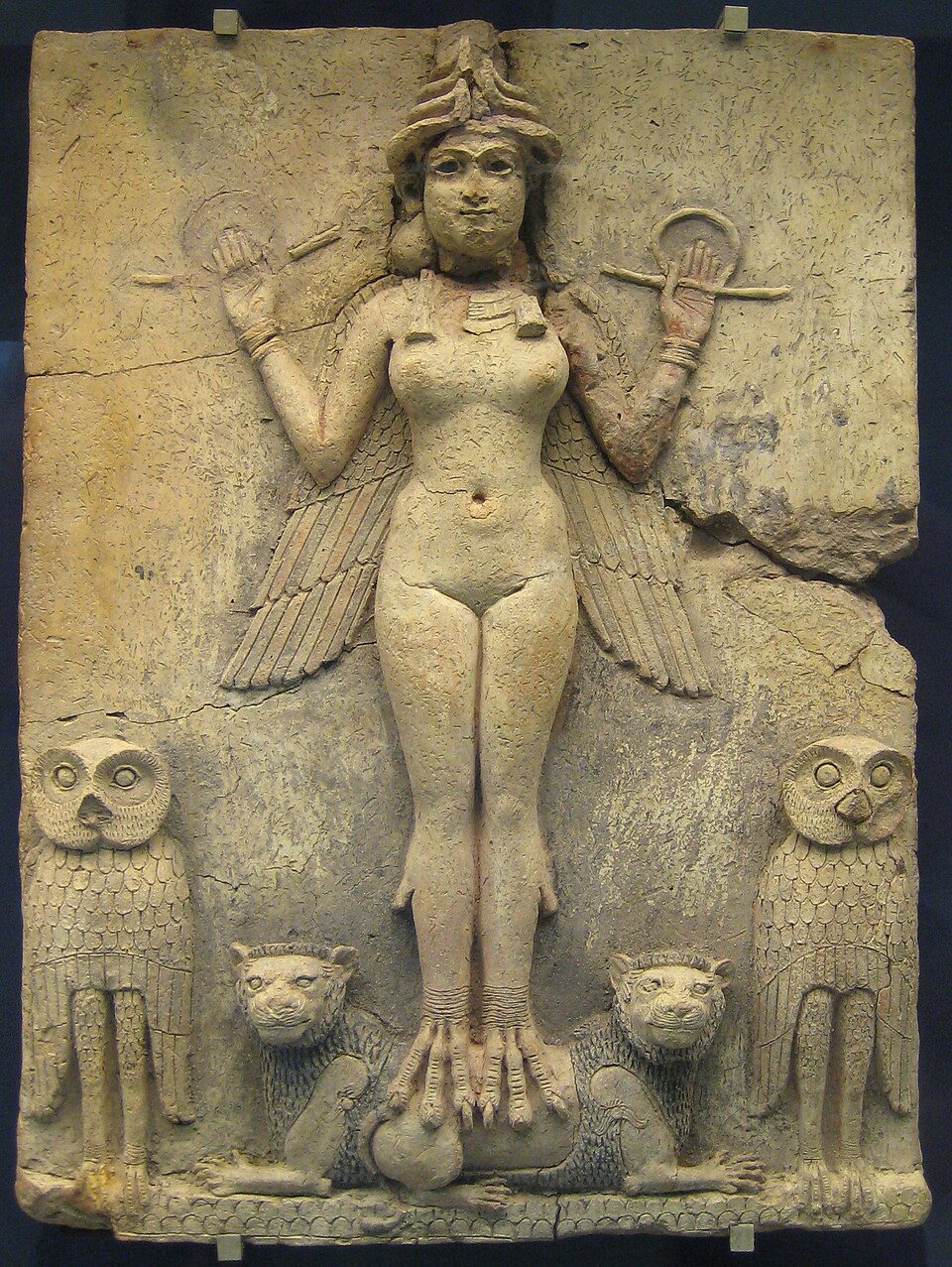
The Queen of the NightThe Burney Relief, a baked clay plaque from southern Iraq, c. 1800 to 1750 BCE. It may show Inanna/Ishtar, Ereshkigal or a demon; nobody knows for sure. British Museum. BabelStone · CC0
The Epic of Gilgamesh 𒀭𒄑𒂆𒈦
Short Sumerian poems about Gilgamesh were written down by about c. 2100 BCE. Later poets joined them into one long epic in Akkadian. The best-known version, on twelve tablets, is credited to a Babylonian scholar named Sin-leqi-unninni, and was found in the library of the Assyrian king Ashurbanipal at Nineveh. Here is the story in nine steps.
1 · The king of Uruk
Gilgamesh is two-thirds god and one-third human, strong and handsome, but he is a bully to his people. They pray to the gods for help.
2 · The wild man
The goddess Aruru shapes a new man from clay: Enkidu. He lives with the gazelles, drinks at the waterholes and frees animals from hunters' traps.
3 · Best friends
Enkidu learns human ways: eating bread, wearing clothes, living in a town. He walks into Uruk and blocks Gilgamesh's path. They wrestle, neither wins, and they become best friends.
4 · The Cedar Forest
The two heroes travel far to the west, to the Cedar Forest, guarded by the giant Humbaba. With help from the sun god Shamash, they defeat him and cut down a great cedar.
5 · The Bull of Heaven
Back home, the goddess Ishtar wants to marry Gilgamesh. He says no, rudely. Furious, she sends the Bull of Heaven to attack Uruk. The friends defeat it together.
6 · A terrible loss
The gods decide one of the heroes must pay. Enkidu falls ill and dies. Gilgamesh mourns him for seven days, and orders a statue of his friend made of gold and lapis lazuli.
7 · The search
Now afraid of death, Gilgamesh travels to the edge of the world to find Utnapishtim, the only man the gods ever made immortal. He passes the scorpion-people and a wise tavern-keeper named Siduri, and crosses the Waters of Death.
8 · The plant of youth
Utnapishtim tells him about the great flood, then reveals a secret plant that makes the old young again. On the way home, Gilgamesh stops to bathe, and a snake steals the plant. It sheds its skin as it slips away.
9 · The walls of Uruk
Gilgamesh comes home empty-handed. He shows the ferryman Urshanabi the mighty walls and gardens of Uruk. The epic ends where it began: what lasts is the city, and the good you leave behind.
Spotlight: Enkidu, the wild friend
𒂗𒆠𒄭
Enkidu is the heart of the story. He starts out as the wildest creature in the land and ends up the most loyal friend in literature. He talks Gilgamesh out of danger, fights beside him, and teaches the proud king how to care about someone else. His name is usually read as "Lord of the good place", from Sumerian en ("lord"), ki ("place") and du ("good"). People have been reading about this friendship for about 4,000 years, and many say it is the first great friendship story ever written down.
A monster who was also a guardian
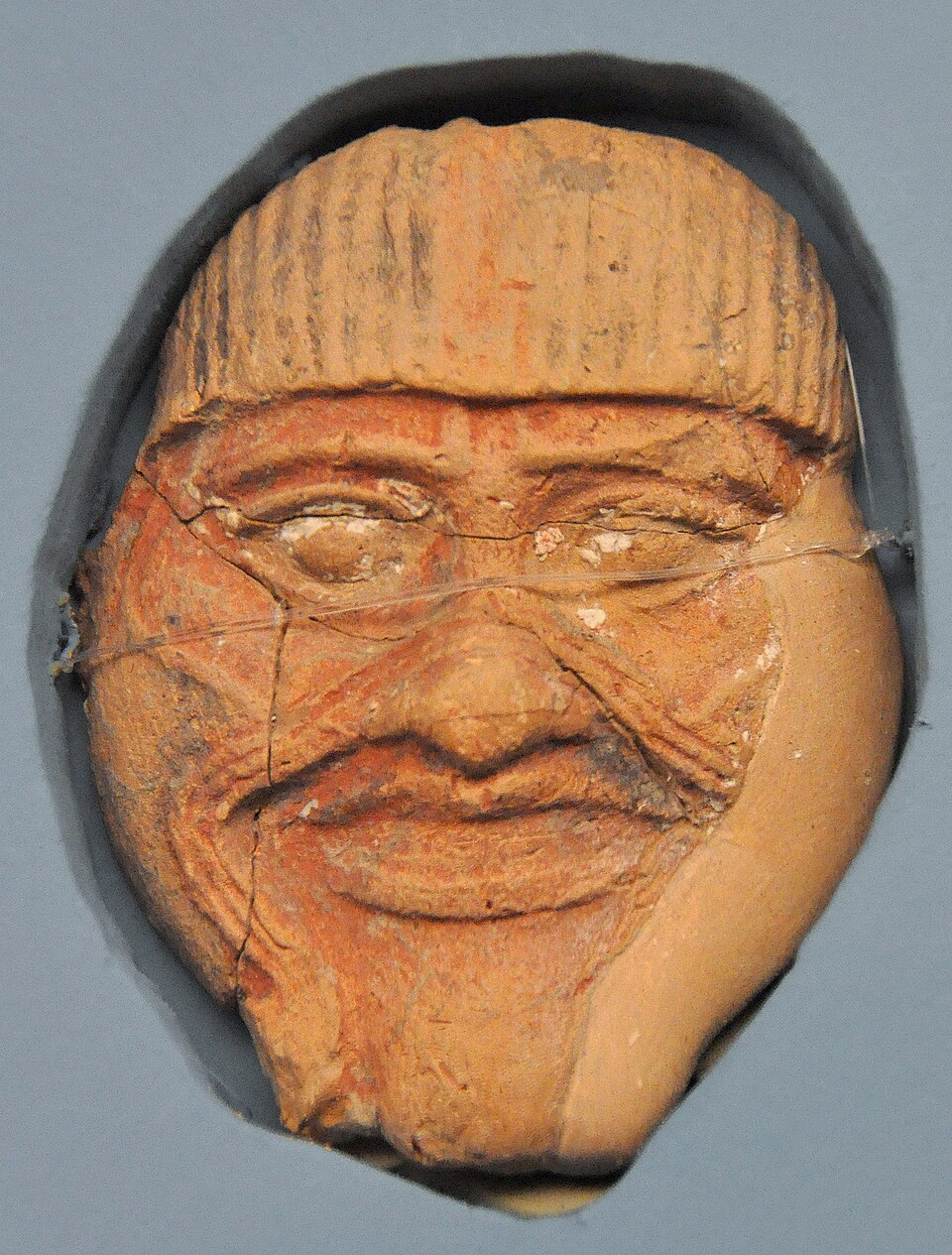
Humbaba (in Sumerian, Huwawa) is the guardian of the Cedar Forest, appointed by the god Enlil to protect it. His face, with its twisting lines, was often modelled in clay. A newly read tablet, published in 2014 and widely reported in 2015, showed the forest as a noisy, beautiful place full of birds, monkeys and insects, with Humbaba enjoying its music like a king at a party. That makes cutting down his forest feel less heroic, and more sad.
The Face of HumbabaClay mask from southern Iraq, Old Babylonian period, c. 2000 to 1600 BCE. Ancient Orient Museum, Istanbul. Osama Shukir Muhammed Amin FRCP(Glasg) · CC BY-SA 4.0
Inanna's journey to the Underworld
This Sumerian poem is one of the oldest stories about a journey into the land of the dead. Inanna, queen of heaven, decides to visit the "Great Below", ruled by her sister Ereshkigal. Before she goes, she tells her loyal helper Ninshubur: if I do not come back in three days, ask the gods for help.
The Underworld has seven gates. At each one, the gatekeeper makes Inanna give up something: her crown, her necklace, her robe, until she arrives with nothing. Ereshkigal and the judges of the dead look at her, and Inanna falls still and lifeless.
Ninshubur keeps her promise. Two gods refuse to help, but clever Enki makes two tiny beings from the dirt under his fingernails. They slip into the Underworld, comfort Ereshkigal, and bring Inanna back to life with the food and water of life.
But nobody leaves the Underworld for free. Someone must take her place. Inanna finds her husband Dumuzi relaxing on his throne instead of mourning her, and he is taken. In the end his kind sister Geshtinanna offers to share the burden: each spends half the year below. Many scholars think this explained the turning of the seasons. A later Akkadian version, The Descent of Ishtar, tells a similar tale.
Flood stories
Mesopotamia was flat land between two rivers that could burst their banks without warning, so it is no surprise that its poets told of a great flood.
In the Atrahasis epic (written down by about c. 1700 BCE), the gods are annoyed by the noise of humans and decide to wipe them out. Enki secretly warns a wise man named Atrahasis to build a boat and save his family and the animals. After the flood, the gods regret what they have done.
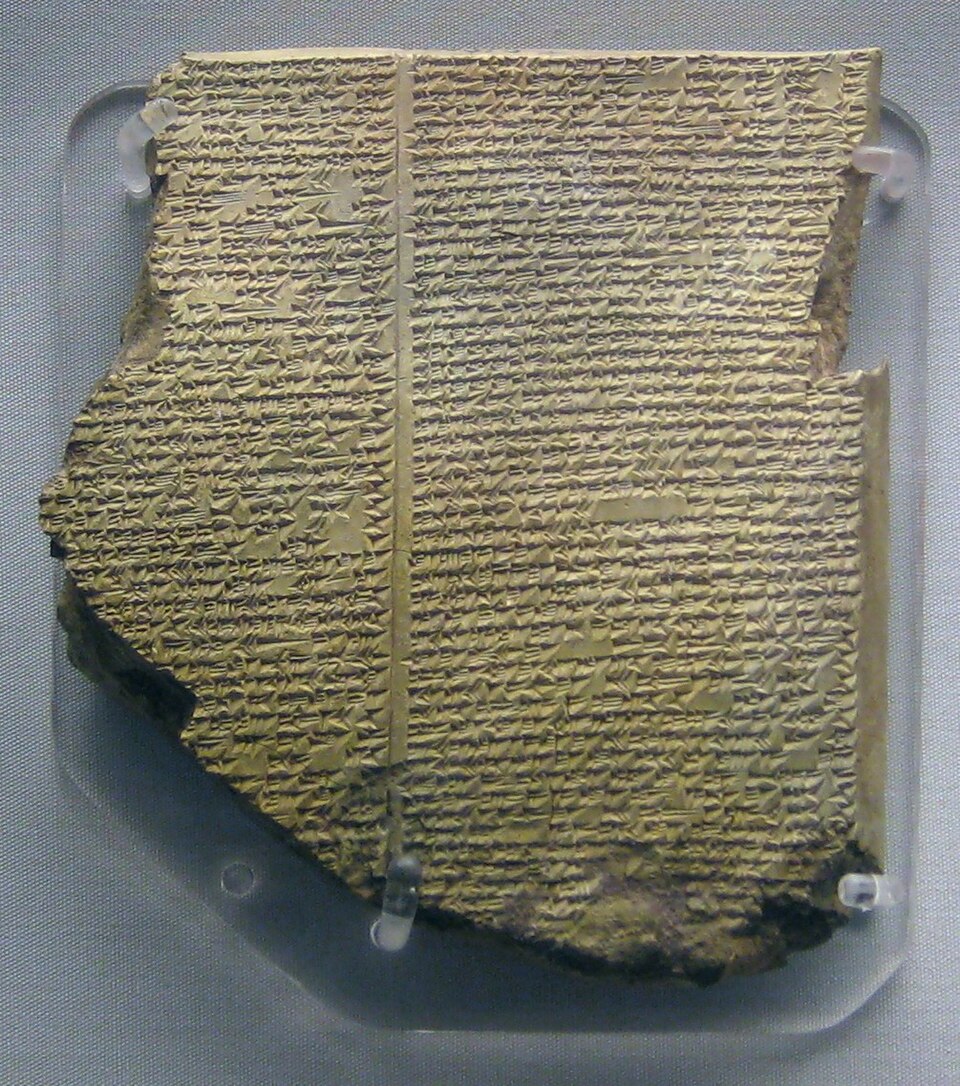
Tablet 11 of Gilgamesh retells the same story through Utnapishtim. His boat comes to rest on a mountain, and he sends out a dove, a swallow and a raven to look for dry land. When the raven does not come back, he knows the water has gone down.
These stories share many features with the later flood story of Noah in the Bible: a warning from God or a god, a boat, animals saved, birds sent out, a mountain, and an offering afterwards. Scholars compare them to understand how stories travelled and changed across the ancient Near East. Different people read these connections in different ways, and this page does not try to say which story is "true".
There is an even older Sumerian flood story, about a king named Ziusudra. All three heroes (Ziusudra, Atrahasis and Utnapishtim) play the same part, and their names all point to the same idea: long life or great wisdom.
Enuma Elish: how Marduk became king Babylon
The Babylonian creation story is named after its first words, Enuma elish, "When on high". It begins before there was sky or land, when there were only two great waters: Apsu (fresh water) and Tiamat (the salt sea). Their children, the younger gods, are noisy, and the old powers grow angry.
Tiamat gathers an army of monsters to destroy the younger gods. They are terrified. Only young Marduk will fight her, on one condition: if he wins, he becomes king of the gods. Armed with the winds, a net and his bow, he defeats Tiamat, and then builds the world from her body: half becomes the sky, half the earth, and her eyes become the sources of the Tigris and Euphrates. He sets the stars and moon in order, humans are made to help the gods, and the gods build Babylon as Marduk's home.
The poem was recited during the akitu, the Babylonian New Year festival held each spring in the month of Nisannu. For about twelve days, the statues of the gods were carried in procession, and the king's right to rule was renewed. In Assyria, scribes made a version where the hero was their own god, Ashur.
Protective spirits and monsters
Mesopotamians believed the world was full of spirits, some helpful, some harmful. People protected their homes and families with images and charms.
Lamassu Assyria
Huge stone guardians with a human head, wings and the body of a bull or lion. They stood at palace gates to keep evil out. Look closely and many have five legs, so they look right from the front and the side.
Pazuzu
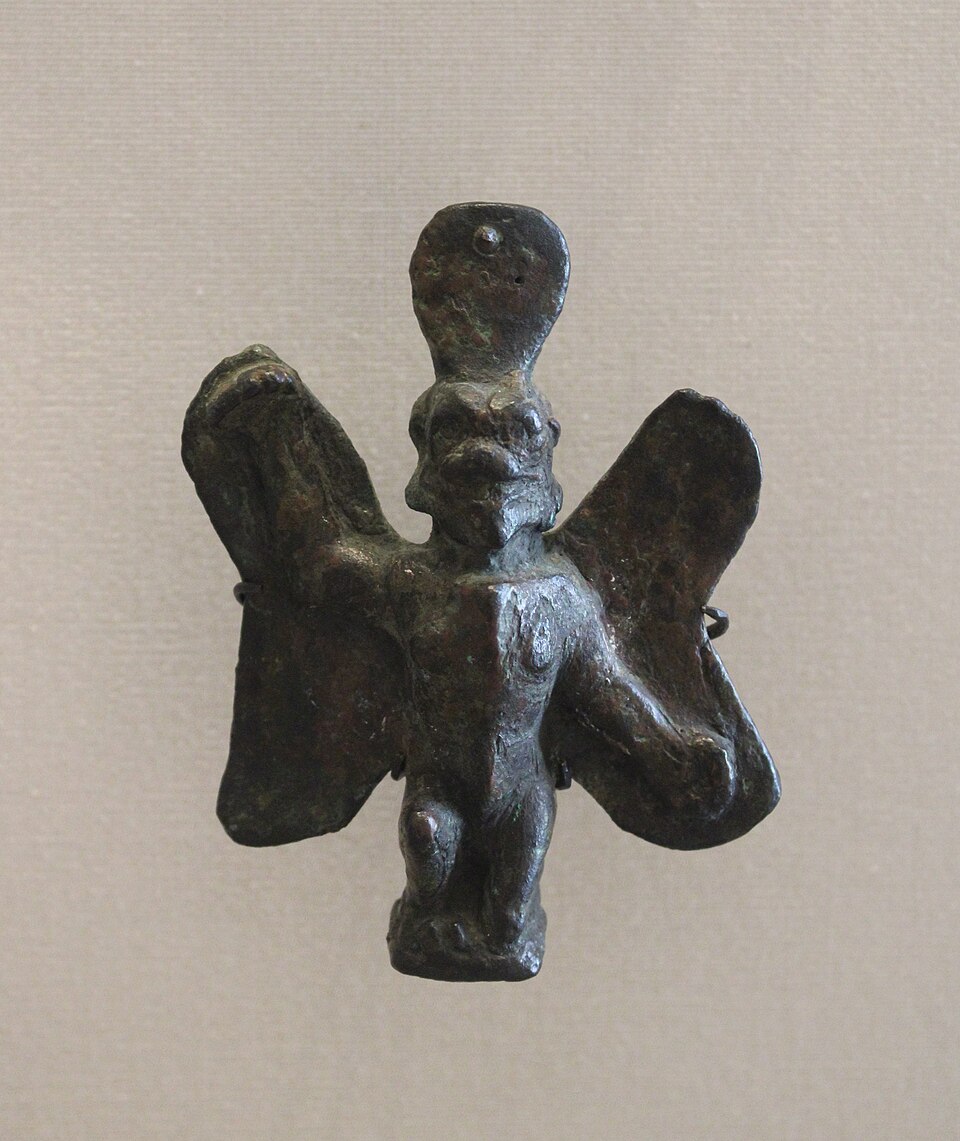
A fierce-looking wind demon with wings and a dog-like face. He looks scary, but people used him as a protector: his image chased away Lamashtu, a demon blamed for harming mothers and babies. Small Pazuzu heads were worn as charms.
Humbaba
The forest guardian from Gilgamesh. Clay images of his face were used as charms, and also by fortune-tellers, whose model sheep's organs had the same twisting lines.
Pazuzu the ProtectorBronze statuette, early 1st millennium BCE, possibly from Uruk. Louvre Museum, Paris. Zunkir · CC BY-SA 4.0
Where the stories survive
Clay is cheap, but it is tough. A sun-dried tablet can last thousands of years in the ground, and fire, which destroys paper, bakes clay harder. When Nineveh was burned in 612 BCE, the tablets in Ashurbanipal's library were buried in the ruins, and many survived. The British Museum holds more than 30,000 tablets and fragments from it.
In 1872, a young British Museum worker named George Smith, who had taught himself to read cuneiform, was sorting fragments when he recognised a flood story on one of them. He announced it in a lecture that December, and it caused a sensation.
The stories are still growing. In 2014, scholars Farouk Al-Rawi and Andrew George published a tablet bought by the Sulaymaniyah Museum in Iraqi Kurdistan, and it made news around the world in 2015. It added about twenty new lines to Tablet V of Gilgamesh, the Cedar Forest episode. And in 2021 the "Gilgamesh Dream Tablet", taken out of Iraq decades earlier, was returned home from the United States. Every new fragment fills in a gap.
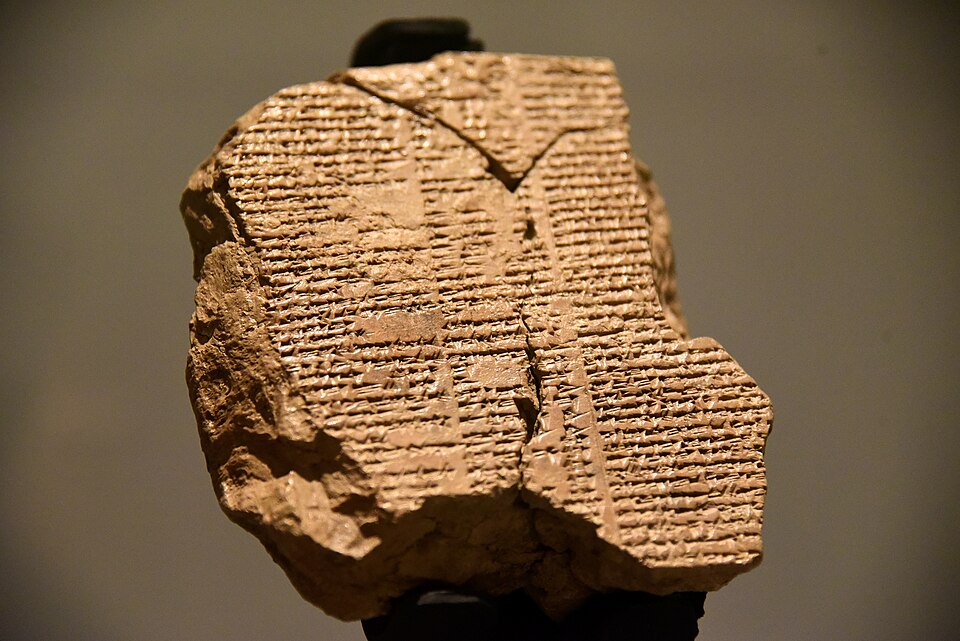
A New Piece of GilgameshThe newly read Tablet V, probably a copy made in the 600s to 500s BCE (the museum label says earlier). Sulaymaniyah Museum, Iraq. Osama Shukir Muhammed Amin FRCP(Glasg) · CC BY-SA 4.0
Source detective: the Flood Tablet
The Flood TabletTablet 11 of the Epic of Gilgamesh, from Ashurbanipal's library at Nineveh, 7th century BCE. British Museum. BabelStone · CC0
Origin
Found at Nineveh (near modern Mosul) in the 1850s, among the broken tablets of Ashurbanipal's library. Copied by an Assyrian scribe in the 600s BCE from older Babylonian versions.
Purpose
Part of a royal library of knowledge. Ashurbanipal collected literature, prayers, medicine and omens so his scholars could advise him.
What it shows
Utnapishtim tells Gilgamesh how the god Ea warned him of a flood, how he built a boat, and how he sent out birds to find land.
How useful?
Very useful for what educated Assyrians read and valued, and for comparing flood stories. Limits: it is a late copy of a much older poem, parts are broken off, and we only see the version one library chose to keep.
Source detective: the Adda Seal
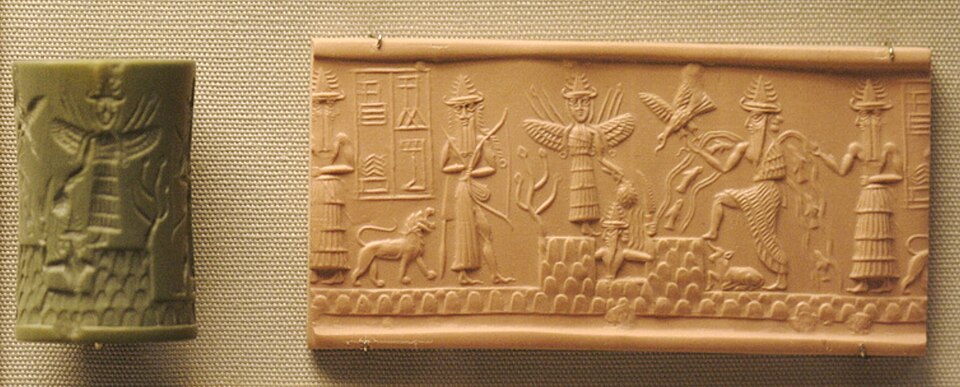
The Adda SealModern impression of an Akkadian cylinder seal, c. 2300 BCE. British Museum. Nic McPhee · CC BY-SA 2.0
Origin
A small stone cylinder carved during the Akkadian Empire. Its inscription names its owner, a scribe called Adda.
Purpose
Rolled across wet clay to "sign" documents and seal jars and doors, like a personal stamp. Its pictures also showed which gods protected the owner.
What it shows
Read it like a cartoon: Ishtar with wings and weapons on her shoulders, the sun god Shamash rising between two mountains with rays coming from his shoulders, and Ea with streams of water and fish flowing from him. Each god is recognised by their symbol.
How useful?
Very useful for how gods were pictured and told apart. Limits: we can't be certain of every figure, the seal shows a scribe's private choice, and the impression we see is modern.
Early dates are estimates; scholars disagree by up to about 60 years. We put "c." (short for circa, "about") in front of them.
Dig deeper
Many gods, many versions
There was no single Mesopotamian "Bible" or rulebook. Over 3,000 years, gods merged, changed families and swapped jobs. Sumerian and Akkadian gods were matched up (Inanna with Ishtar, Utu with Shamash), and lists of gods compiled by scribes, like the great list known as An = Anum, contain around 2,000 names. City politics mattered: when Babylon rose, Marduk took on Enlil's powers; when Assyria rose, Ashur did the same. Religion in Mesopotamia was also practical. Divination (reading omens in sheep's livers, stars and dreams) was a serious science used by kings.
How the Gilgamesh epic grew
There are at least three layers. Five separate Sumerian poems (c. 2100 BCE onwards, probably composed for the Ur III kings, who claimed Gilgamesh as an ancestor). An Old Babylonian Akkadian epic (c. 1800 BCE), known as "Surpassing all other kings". And the Standard Babylonian version, "He who saw the deep", credited to Sin-leqi-unninni (perhaps c. 1200 BCE). Tablet 12, a translation of the Sumerian poem "Gilgamesh, Enkidu and the Netherworld", sits awkwardly after the ending, and scholars debate why it was added. Copies have been found as far away as Megiddo in Israel and Hattusa in Turkey, and the story was translated into Hittite and Hurrian.
Enkidu and Shamhat
In the epic, Enkidu is brought into human society by Shamhat, a woman from the temple of Ishtar in Uruk. Read as literature, this part is about the move from wild to civilised: bread, beer, clothes and shepherding. When dying, Enkidu at first curses her, then the sun god reminds him of the friendship she led him to, and he blesses her instead. Andrew George's translation is a good place to read this in full.
Flood stories compared
The flood in Atrahasis is the gods' last attempt to control human numbers after plague and famine. In Gilgamesh, the flood is told as a story within a story, and its message is that even the hero who survived it cannot give immortality away. Since George Smith's announcement in 1872, scholars have debated how the Mesopotamian and Biblical accounts are related; most see shared traditions across the region, adapted with very different ideas about God or the gods. Some geologists have linked the stories to real river floods found in layers at Ur, Shuruppak and Kish, but those floods were local and at different times.
When was Enuma Elish written?
The oldest copies come from the 1st millennium BCE, but many scholars think it was composed earlier, possibly in the reign of Nebuchadnezzar I (c. 1125 to 1104 BCE), when Marduk's statue was brought back to Babylon from Elam. Others argue for the Old Babylonian period. It is less a story about the beginning of everything and more a hymn explaining why Marduk, and Babylon, deserve to rule.
Heritage and today
These stories belong to the shared heritage of all Iraqis, and to world literature. Iraqi archaeologists, curators and translators continue to recover, conserve and publish tablets, sometimes after looting and smuggling. The return of the Gilgamesh Dream Tablet to Baghdad in 2021 was celebrated as part of a wider effort to bring stolen objects home.
Books: Andrew George, The Epic of Gilgamesh (Penguin); Stephanie Dalley, Myths from Mesopotamia (Oxford World's Classics); Jeremy Black and Anthony Green, Gods, Demons and Symbols of Ancient Mesopotamia.